## Overview
Coral NPU is a RISC-V CPU built for custom single-instruction, multiple data
(SIMD) instructions and microarchitectural features that align with the
dataplane properties of an ML accelerator. The design of Coral NPU starts with
domain and matrix capabilities --- vector and scalar capabilities are then
added for a fused architecture.
## Scalar core
The scalar CPU front-end of Coral NPU provides the RISC-V 32-bit ISA base. This
brings pre-existing compiler and library support from the broader software
ecosystem. The scalar front-end is a C-programmable CPU in which loops and
control flow enable sophisticated composition of vector ML engines. It provides
a single development environment where the ML/SIMD/scalar computations have a
unified memory model and control flow, thus simplifying the programming model.
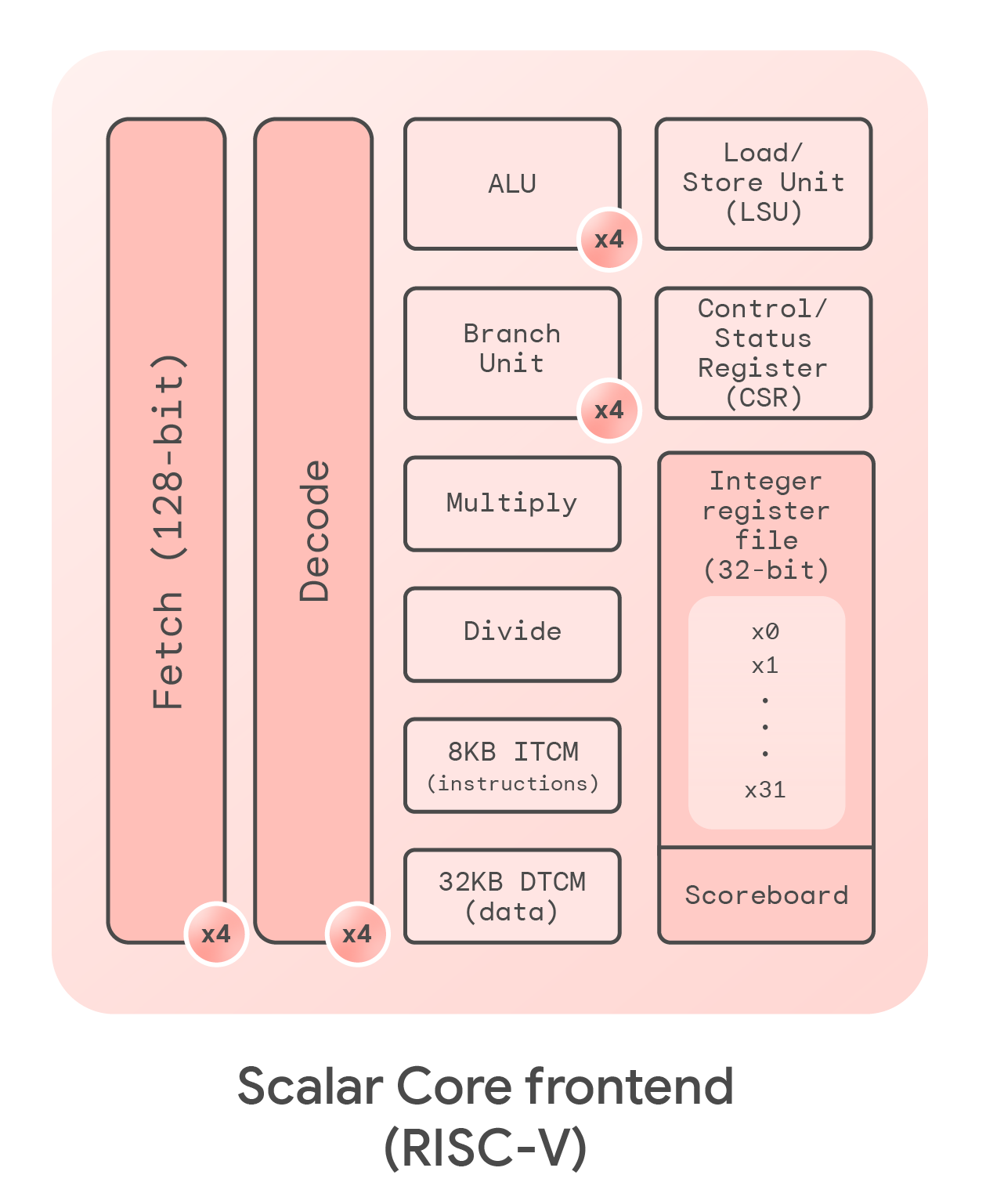
This core is a scalar front-end that drives the command queues of the
ML-and-SIMD back-end. It runs the minimal set of instructions needed to support
an executor run-to-completion model (no OS, no interrupts), with all control
tasks onloaded to the SMC.
The branch policy in the fetch stage is backwards branches are taken and forward
branches are not taken, incurring a penalty cycle if the execute result does not
match the decision in the fetch unit.
## Vector execution engine
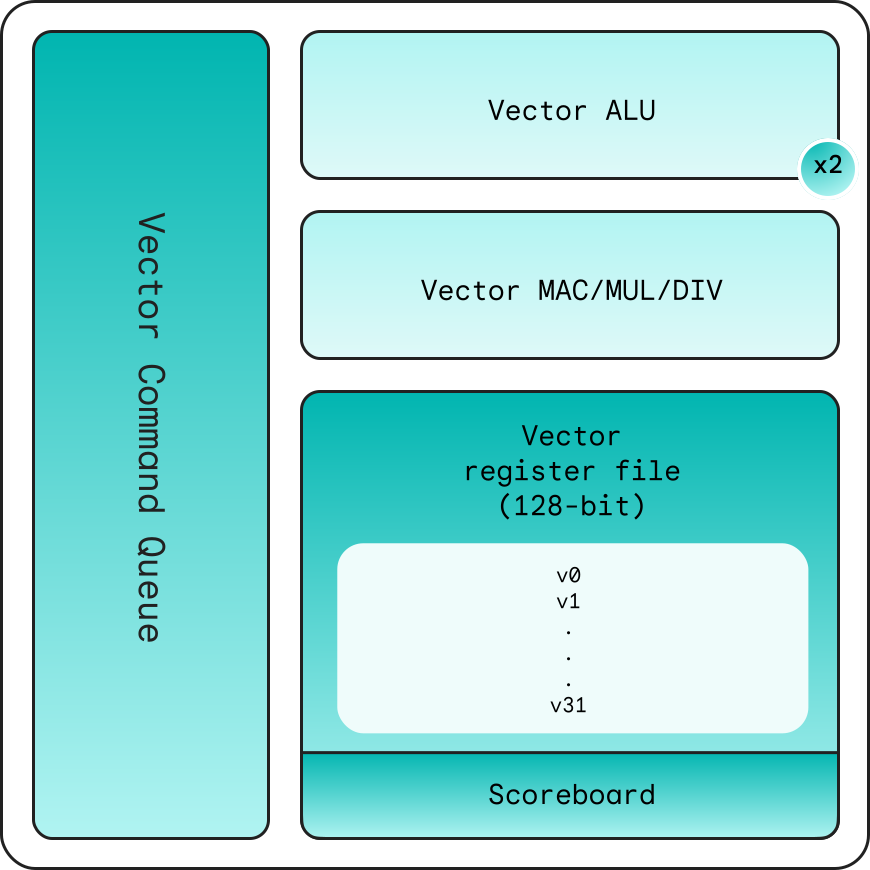
Coral NPU features a SIMD architecture for vector compute operations. The terms
SIMD and vector are used interchangeably here, referring to a simple and
practical SIMD instruction definition devoid of variable-length behaviors.
Coral's scalar front-end is decoupled from the back-end by a FIFO structure that
buffers vector instructions, posting only to the relevant command queues when
dependencies are resolved in the vector register file (regfile). The vector core
supports data widths of 8, 16, and 32 bits.
Large classes of computing can be solved with 1) ML activation functions, and 2)
reductions. Data movement benefits from vector instructions in that:
- Transposition/loads/stores are common in a vector ISA.
- An outer-product engine can be fed by SIMD registers.
With Coral NPU's simplified programming model, compilers can auto-vectorize code
and leverage pre-existing developer experience with NEON/SSE instruction sets.
## Matrix (MAC) execution engine
The central component of the Coral NPU architecture is a quantized outer-product
multiply-accumulate (MAC) engine. An outer-product engine provides
two-dimensional broadcast structures to maximize the amount of deliverable
compute with respect to memory accesses.
Coral NPU is designed to be simple for compilers to support even with ML domain
specialization:
- Compute requirements in ML models are dominated by matrix multiplication.
- Outer-product multiplication circuit enables N x M x K MACs/cycle compute, with typical values of N=8, M=8, K=4, NxMxK=256. This can be parameterized to suit the application domain.
- Convolution, etc., can be expressed using *matmuls* as sub-operations.
- In a fixed-function accelerator, only *matmuls* are performed, with limited control flow.
On one axis is a parallel broadcast (*wide* , convolution weights), and on the
other axis the transpose-shifted inputs of a number of batches (*narrow*, for
example MobileNet XY batching).
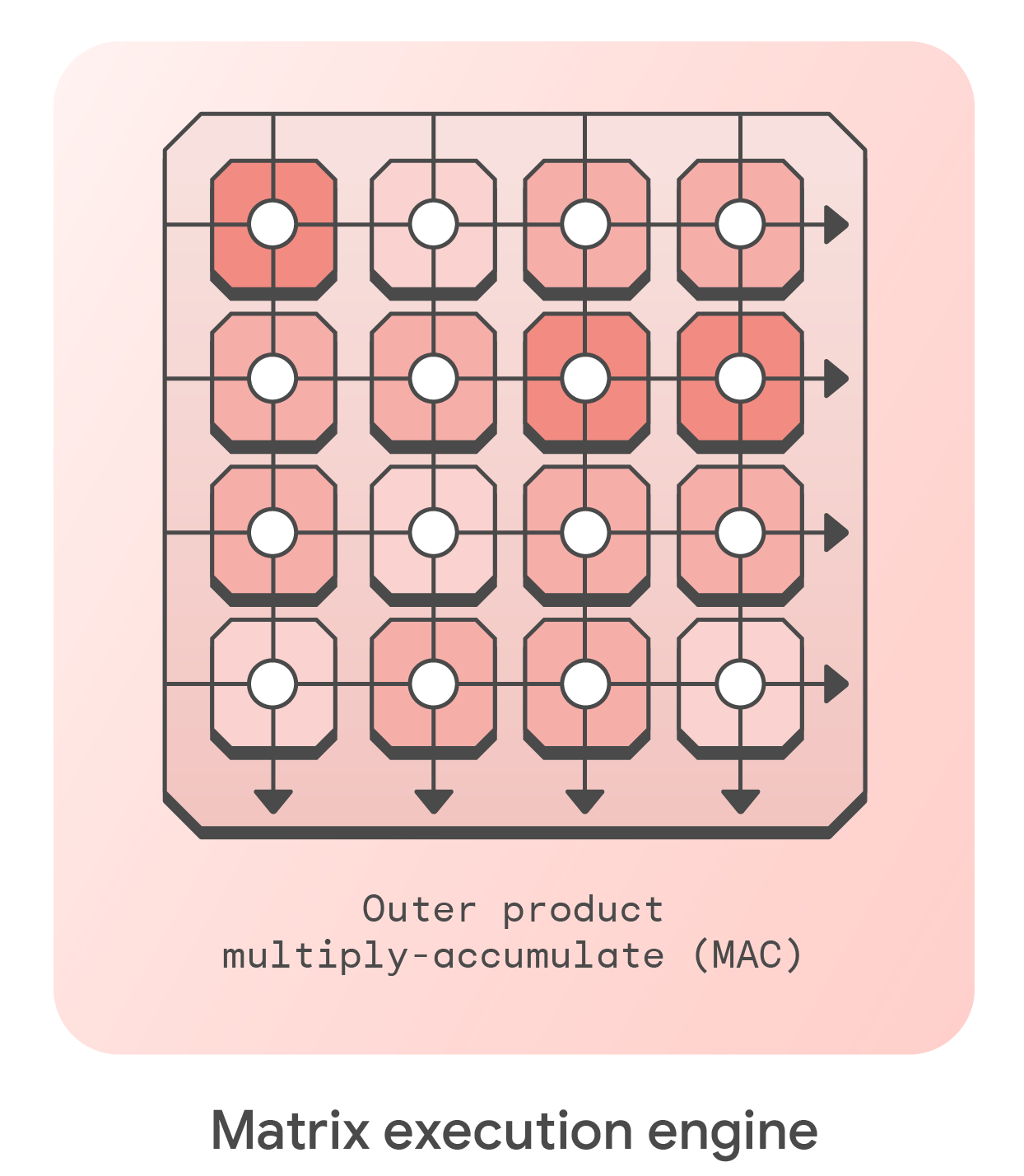
The outer-product construction is a vertical arrangement of multiple VDOT
opcodes that utilize 4 x 8-bit multiplies reduced into 32-bit accumulators. This
is capable of performing 256 MACs per-cycle.
*** ** * ** ***