# Decision trees
Decision forest models are composed of decision trees. Decision forest
learning algorithms (like random forests) rely, at least in part, on the
learning of decision trees.
In this section of the course, you will study a small example dataset, and learn
how a single decision tree is trained. In the next sections, you will learn how
decision trees are combined to train decision forests.
YDF Code
In YDF, use the CART learner to train individual decision tree models:
```
# https://ydf.readthedocs.io/en/latest/py_api/CartLearner
import ydf
model = ydf.CartLearner(label="my_label").train(dataset)
```
## The model
A **decision tree** is a model composed of a collection of "questions" organized
hierarchically in the shape of a tree. The questions are usually called a
**condition,** a **split** , or a **test.** We will use the term "condition" in
this class. Each non-leaf node contains a condition, and each leaf node contains
a prediction.
Botanical trees generally grow with the root at the bottom; however, decision
trees are usually represented with the **root** (the first node) at the top.
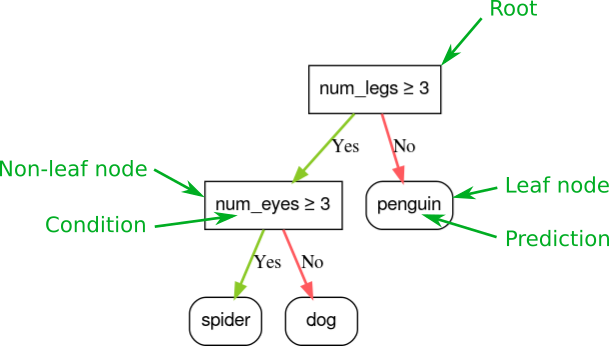
**Figure 1. A simple classification decision tree. The legend in green is not part
of the decision tree.**
Inference of a decision tree model is computed by routing an example from the
root (at the top) to one of the leaf nodes (at the bottom) according to the
conditions. The value of the reached leaf is the decision tree's prediction.
The set of visited nodes is called the **inference path**. For example,
consider the following feature values:
| num_legs | num_eyes |
|---|---|
| 4 | 2 |
The prediction would be *dog*. The inference path would be:
1. num_legs ≥ 3 → Yes
2. num_eyes ≥ 3 → No
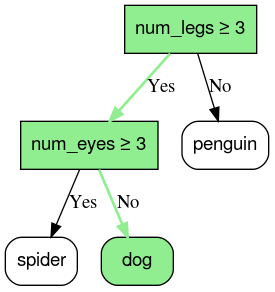
**Figure 2. The inference path that culminates in the leaf \*dog\* on the example
\*{num_legs : 4, num_eyes : 2}\*.**
In the previous example, the leaves of the decision tree contain classification
predictions; that is, each leaf contains an animal species among a set
of possible species.
Similarly, decision trees can predict numerical values by labeling leaves with
regressive predictions (numerical values). For example, the following decision
tree predicts a numerical cuteness score of an animal between 0 and 10.
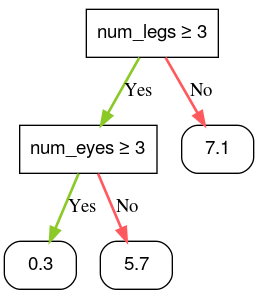
**Figure 3. A decision tree that makes numerical prediction.**