# GAN Variations
Researchers continue to find improved GAN techniques and new uses for GANs.
Here's a sampling of GAN variations to give you a sense of the possibilities.
## Progressive GANs
In a progressive GAN, the generator's first layers produce very low resolution
images, and subsequent layers add details. This technique allows the GAN to
train more quickly than comparable non-progressive GANs, and produces higher
resolution images.
For more information see [Karras et al, 2017](https://arxiv.org/abs/1710.10196).
## Conditional GANs
Conditional GANs train on a labeled data set and let you specify the label for
each generated instance. For example, an unconditional MNIST GAN would produce
random digits, while a conditional MNIST GAN would let you specify which digit
the GAN should generate.
Instead of modeling the joint probability P(X, Y), conditional GANs model the
conditional probability P(X \| Y).
For more information about conditional GANs, see [Mirza et al, 2014](https://arxiv.org/abs/1411.1784).
## Image-to-Image Translation
Image-to-Image translation GANs take an image as input and map it to a generated
output image with different properties. For example, we can take a mask image
with blob of color in the shape of a car, and the GAN can fill in the shape with
photorealistic car details.
Similarly, you can train an image-to-image GAN to take sketches of handbags and
turn them into photorealistic images of handbags.
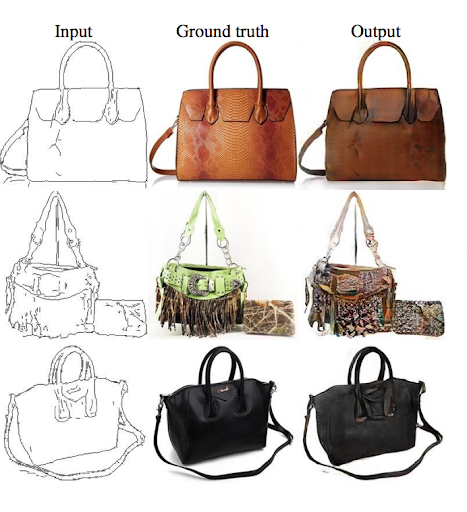
In these cases, the loss is a weighted combination of the usual
discriminator-based loss and a pixel-wise loss that penalizes the generator for
departing from the source image.
For more information, see [Isola et al, 2016](https://arxiv.org/abs/1611.07004).
## CycleGAN
CycleGANs learn to transform images from one set into images that could
plausibly belong to another set. For example, a CycleGAN produced the righthand
image below when given the lefthand image as input. It took an image of a
horse and turned it into an image of a zebra.
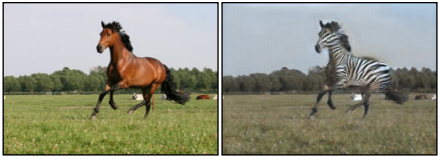
The training data for the CycleGAN is simply two sets of images (in this
case, a set of horse images and a set of zebra images). The system requires no
labels or pairwise correspondences between images.
For more information see [Zhu et al,
2017](http://openaccess.thecvf.com/content_ICCV_2017/papers/Zhu_Unpaired_Image-To-Image_Translation_ICCV_2017_paper.pdf),
which illustrates the use of CycleGAN to perform image-to-image translation
without paired data.
## Text-to-Image Synthesis
Text-to-image GANs take text as input and produce images that are plausible and
described by the text. For example, the flower image below was produced by
feeding a text description to a GAN.
|---|---|
| "This flower has petals that are yellow with shades of orange." |  |
Note that in this system the GAN can only produce images from a small set of
classes.
For more information, see [Zhang et al, 2016](https://arxiv.org/abs/1612.03242).
## Super-resolution
Super-resolution GANs increase the resolution of images, adding detail where
necessary to fill in blurry areas. For example, the blurry middle image below
is a downsampled version of the original image on the left. Given the blurry
image, a GAN produced the sharper image on the right:
|---|---|---|
| Original | Blurred | Restored with GAN |
|  |  |  |
The GAN-generated image looks very similar to the original image, but if you
look closely at the headband you'll see that the GAN didn't reproduce the
starburst pattern from the original. Instead, it made up its own plausible
pattern to replace the pattern erased by the down-sampling.
For more information, see [Ledig et al,
2017](https://arxiv.org/pdf/1609.04802.pdf).
## Face Inpainting
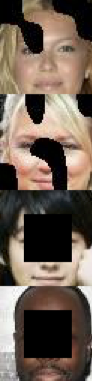
GANs have been used for the *semantic image inpainting* task. In the inpainting
task, chunks of an image are blacked out, and the system tries to fill in the
missing chunks.
[Yeh et al, 2017](https://arxiv.org/pdf/1607.07539.pdf) used a GAN to outperform
other techniques for inpainting images of faces:
|---|---|
| Input | GAN Output |
|  |  |
## Text-to-Speech
Not all GANs produce images. For example, researchers have also used GANs to
produce synthesized speech from text input. For more information see [Yang et
al, 2017](https://arxiv.org/pdf/1707.01670.pdf).