# Machine Learning Glossary: Clustering
This page contains Clustering glossary terms. For all glossary terms,
[click here](https://developers.google.com/machine-learning/glossary).
## A
## agglomerative clustering
#clustering
See [**hierarchical clustering**](https://developers.google.com/machine-learning/glossary/clustering#hierarchical_clustering).
## C
## centroid
#clustering
The center of a cluster as determined by a [**k-means**](https://developers.google.com/machine-learning/glossary/clustering#k-means) or
[**k-median**](https://developers.google.com/machine-learning/glossary/clustering#k-median) algorithm. For example, if k is 3,
then the k-means or k-median algorithm finds 3 centroids.
See [Clustering algorithms](https://developers.google.com/machine-learning/clustering/clustering-algorithms)
in the Clustering course for more information.
## centroid-based clustering
#clustering
A category of [**clustering**](https://developers.google.com/machine-learning/glossary/clustering#clustering) algorithms that organizes data
into nonhierarchical clusters. [**k-means**](https://developers.google.com/machine-learning/glossary/clustering#k-means) is the most widely
used centroid-based clustering algorithm.
Contrast with [**hierarchical clustering**](https://developers.google.com/machine-learning/glossary/clustering#hierarchical_clustering)
algorithms.
See [Clustering algorithms](https://developers.google.com/machine-learning/clustering/clustering-algorithms)
in the Clustering course for more information.
## clustering
#clustering
Grouping related [**examples**](https://developers.google.com/machine-learning/glossary#example), particularly during
[**unsupervised learning**](https://developers.google.com/machine-learning/glossary/clustering#unsupervised_machine_learning). Once all the
examples are grouped, a human can optionally supply meaning to each cluster.
Many clustering algorithms exist. For example, the [**k-means**](https://developers.google.com/machine-learning/glossary/clustering#k-means)
algorithm clusters examples based on their proximity to a
[**centroid**](https://developers.google.com/machine-learning/glossary/clustering#centroid), as in the following diagram:
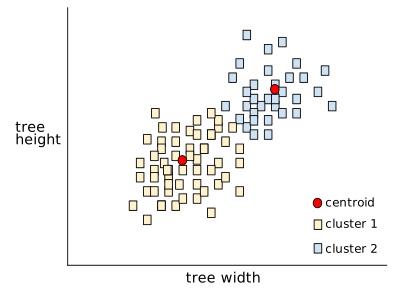
A human researcher could then review the clusters and, for example,
label cluster 1 as "dwarf trees" and cluster 2 as "full-size trees."
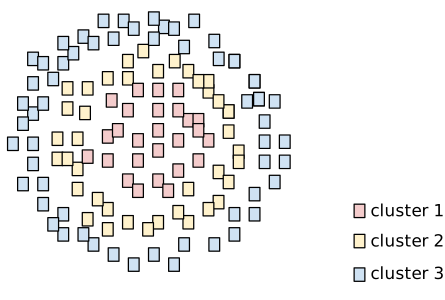
As another example, consider a clustering algorithm based on an
example's distance from a center point, illustrated as follows:
See the [Clustering course](https://developers.google.com/machine-learning/clustering)
for more information.
## D
## divisive clustering
#clustering
See [**hierarchical clustering**](https://developers.google.com/machine-learning/glossary/clustering#hierarchical_clustering).
## H
## hierarchical clustering
#clustering
A category of [**clustering**](https://developers.google.com/machine-learning/glossary/clustering#clustering) algorithms that create a tree
of clusters. Hierarchical clustering is well-suited to hierarchical data,
such as botanical taxonomies. There are two types of hierarchical
clustering algorithms:
- **Agglomerative clustering** first assigns every example to its own cluster, and iteratively merges the closest clusters to create a hierarchical tree.
- **Divisive clustering** first groups all examples into one cluster and then iteratively divides the cluster into a hierarchical tree.
Contrast with [**centroid-based clustering**](https://developers.google.com/machine-learning/glossary/clustering#centroid_based_clustering).
See [Clustering
algorithms](https://developers.google.com/machine-learning/clustering/clustering-algorithms)
in the Clustering course for more information.
## K
## k-means
#clustering
A popular [**clustering**](https://developers.google.com/machine-learning/glossary/clustering#clustering) algorithm that groups examples
in unsupervised learning. The k-means algorithm basically does the following:
- Iteratively determines the best k center points (known as [**centroids**](https://developers.google.com/machine-learning/glossary/clustering#centroid)).
- Assigns each example to the closest centroid. Those examples nearest the same centroid belong to the same group.
The k-means algorithm picks centroid locations to minimize the cumulative
*square* of the distances from each example to its closest centroid.
For example, consider the following plot of dog height to dog width:
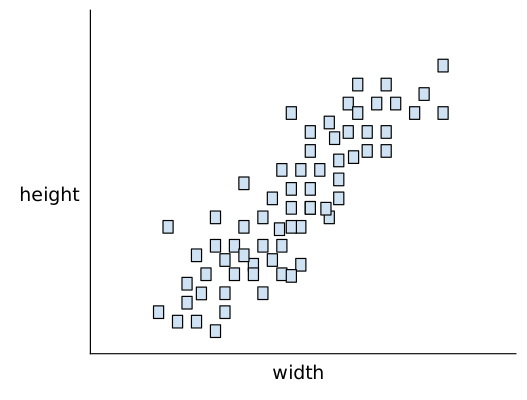
If k=3, the k-means algorithm will determine three centroids. Each example
is assigned to its closest centroid, yielding three groups:
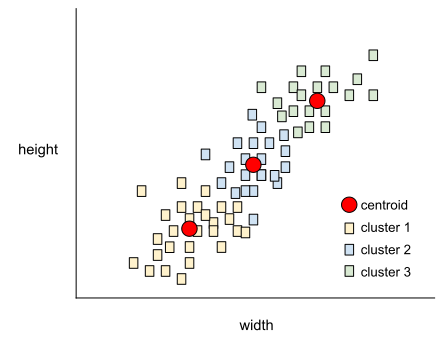
Imagine that a manufacturer wants to determine the ideal sizes for small,
medium, and large sweaters for dogs. The three centroids identify the mean
height and mean width of each dog in that cluster. So, the manufacturer
should probably base sweater sizes on those three centroids. Note that
the centroid of a cluster is typically *not* an example in the cluster.
The preceding illustrations shows k-means for examples with only
two features (height and width). Note that k-means can group examples
across many features.
See [What is k-means clustering?](https://developers.google.com/machine-learning/clustering/kmeans/overview)
in the Clustering course for more information.
## k-median
#clustering
A clustering algorithm closely related to [**k-means**](https://developers.google.com/machine-learning/glossary/clustering#k-means). The
practical difference between the two is as follows:
- In k-means, centroids are determined by minimizing the sum of the *squares* of the distance between a centroid candidate and each of its examples.
- In k-median, centroids are determined by minimizing the sum of the distance between a centroid candidate and each of its examples.
Note that the definitions of distance are also different:
- k-means relies on the [Euclidean distance](https://wikipedia.org/wiki/Euclidean_distance) from the centroid to an example. (In two dimensions, the Euclidean distance means using the Pythagorean theorem to calculate the hypotenuse.) For example, the k-means distance between (2,2) and (5,-2) would be:
$$ {\\text{Euclidean distance}} = {\\sqrt {(2-5)\^2 + (2--2)\^2}} = 5 $$
- k-median relies on the [Manhattan distance](https://wikipedia.org/wiki/Taxicab_geometry) from the centroid to an example. This distance is the sum of the absolute deltas in each dimension. For example, the k-median distance between (2,2) and (5,-2) would be:
$$ {\\text{Manhattan distance}} = \\lvert 2-5 \\rvert + \\lvert 2--2 \\rvert = 7 $$
## S
## similarity measure
#clustering #Metric
In [**clustering**](https://developers.google.com/machine-learning/glossary/clustering#clustering) algorithms, the metric used to determine
how alike (how similar) any two examples are.
## sketching
#clustering
In [**unsupervised machine learning**](https://developers.google.com/machine-learning/glossary/clustering#unsupervised_machine_learning),
a category of algorithms that perform a preliminary similarity analysis
on examples. Sketching algorithms use a
[locality-sensitive hash function](https://wikipedia.org/wiki/Locality-sensitive_hashing)
to identify points that are likely to be similar, and then group
them into buckets.
Sketching decreases the computation required for similarity calculations
on large datasets. Instead of calculating similarity for every single
pair of examples in the dataset, we calculate similarity only for each
pair of points within each bucket.
## T
## time series analysis
#clustering
A subfield of machine learning and statistics that analyzes
[**temporal data**](https://developers.google.com/machine-learning/glossary#temporal-data). Many types of machine learning
problems require time series analysis, including classification, clustering,
forecasting, and anomaly detection. For example, you could use
time series analysis to forecast the future sales of winter coats by month
based on historical sales data.
## U
## unsupervised machine learning
#clustering #fundamentals
Training a [**model**](https://developers.google.com/machine-learning/glossary#model) to find patterns in a dataset, typically an
unlabeled dataset.
The most common use of unsupervised machine learning is to
[**cluster**](https://developers.google.com/machine-learning/glossary/clustering#clustering) data
into groups of similar examples. For example, an unsupervised machine
learning algorithm can cluster songs based on various properties
of the music. The resulting clusters can become an input to other machine
learning algorithms (for example, to a music recommendation service).
Clustering can help when useful labels are scarce or absent.
For example, in domains such as anti-abuse and fraud, clusters can help
humans better understand the data.
Contrast with [**supervised machine learning**](https://developers.google.com/machine-learning/glossary#supervised_machine_learning).
#### Click the icon for additional notes.
Another example of unsupervised machine learning is
[principal component analysis (PCA)](https://wikipedia.org/wiki/Principal_component_analysis).
For example, applying PCA on a
dataset containing the contents of millions of shopping carts might reveal
that shopping carts containing lemons frequently also contain antacids.
*** ** * ** ***
See [What is Machine Learning?](https://developers.google.com/machine-learning/intro-to-ml/what-is-ml)
in the Introduction to ML course for more information.