This page contains Generative AI glossary terms. For all glossary terms,
[click here](https://developers.google.com/machine-learning/glossary).
## A
## adaptation
#generativeAI
Synonym for tuning or [**fine-tuning**](https://developers.google.com/machine-learning/glossary/generative#fine-tuning).
## agent
#generativeAI #agent
Software that can reason about user inputs in order
to plan and execute actions on behalf of the user.
In [**reinforcement learning**](https://developers.google.com/machine-learning/glossary#reinforcement_learning),
an agent is the entity that uses a
[**policy**](https://developers.google.com/machine-learning/glossary#policy) to maximize the expected [**return**](https://developers.google.com/machine-learning/glossary#return) gained from
transitioning between [**states**](https://developers.google.com/machine-learning/glossary#state) of the
[**environment**](https://developers.google.com/machine-learning/glossary#environment).
## agentic
#generativeAI #agent
The adjective form of [**agent**](https://developers.google.com/machine-learning/glossary/generative#agent). Agentic refers to the qualities
that agents possess (such as autonomy).
## agentic workflow
#generativeAI #agent
A dynamic process in which an [**agent**](https://developers.google.com/machine-learning/glossary/generative#agent) autonomously plans and
executes actions to achieve a goal. The process may involve reasoning,
invoking external tools, and self-correcting its plan.
## AI slop
#generativeAI
Output from a [**generative AI**](https://developers.google.com/machine-learning/glossary/generative#generative-AI) system that favors
quantity over quality. For example, a web page with AI slop is filled
with cheaply produced, AI-generated, low-quality content.
## automatic evaluation
#generativeAI
Using software to judge the quality of a model's output.
When model output is relatively straightforward, a script or program can
compare the model's output to a [**golden response**](https://developers.google.com/machine-learning/glossary/generative#golden-response).
This type of automatic evaluation is sometimes called
**programmatic evaluation** . Metrics such as [**ROUGE**](https://developers.google.com/machine-learning/glossary#ROUGE) or
[**BLEU**](https://developers.google.com/machine-learning/glossary#BLEU) are often useful for programmatic evaluation.
When model output is complex or has
[**no one right answer**](https://developers.google.com/machine-learning/glossary/generative#no-one-right-answer), a separate ML program called an
[**autorater**](https://developers.google.com/machine-learning/glossary/generative#autorater-evaluation) sometimes performs the automatic
evaluation.
Contrast with [**human evaluation**](https://developers.google.com/machine-learning/glossary/generative#human-evaluation).
## autorater evaluation
#generativeAI A hybrid mechanism for judging the quality of a [**generative AI**](https://developers.google.com/machine-learning/glossary/generative#generative-AI) model's output that combines [**human evaluation**](https://developers.google.com/machine-learning/glossary/generative#human-evaluation) with [**automatic evaluation**](https://developers.google.com/machine-learning/glossary/generative#automatic-evaluation). An autorater is an ML model trained on data created by [**human evaluation**](https://developers.google.com/machine-learning/glossary/generative#human-evaluation). Ideally, an autorater learns to mimic a human evaluator.
Prebuilt autoraters are available, but the best autoraters are
fine-tuned specifically to the task you are evaluating.
> [!NOTE]
> **Note:** A running autorater is a fully automated process; humans "only" provide data that helps *train* an autorater.
## auto-regressive model
#generativeAI
A [**model**](https://developers.google.com/machine-learning/glossary#model) that infers a prediction based on its own previous
predictions. For example, auto-regressive language models predict the next
[**token**](https://developers.google.com/machine-learning/glossary#token) based on the previously predicted tokens.
All [**Transformer**](https://developers.google.com/machine-learning/glossary#transformer)-based
[**large language models**](https://developers.google.com/machine-learning/glossary/generative#large-language-model) are auto-regressive.
In contrast, [**GAN**](https://developers.google.com/machine-learning/glossary#GAN)-based image models are usually not auto-regressive
since they generate an image in a single forward-pass and not iteratively in
steps. However, certain image generation models *are* auto-regressive because
they generate an image in steps.
## B
## base model
#generativeAI
A [**pre-trained model**](https://developers.google.com/machine-learning/glossary/generative#pre-trained-model) that can serve as the starting
point for [**fine-tuning**](https://developers.google.com/machine-learning/glossary/generative#fine-tuning) to address specific tasks or
applications.
See also [**pre-trained model**](https://developers.google.com/machine-learning/glossary/generative#pre-trained-model)
and [**foundation model**](https://developers.google.com/machine-learning/glossary/generative#foundation-model).
## C
## chain-of-thought prompting
#generativeAI
A [**prompt engineering**](https://developers.google.com/machine-learning/glossary/generative#prompt-engineering) technique that encourages
a [**large language model**](https://developers.google.com/machine-learning/glossary/generative#large-language-model) (LLM) to explain its
reasoning, step by step. For example, consider the following prompt, paying
particular attention to the second sentence:
> How many g forces would a driver experience in a car that goes from 0 to 60
> miles per hour in 7 seconds? In the answer, show all relevant calculations.
The LLM's [**response**](https://developers.google.com/machine-learning/glossary/generative#response) would likely:
- Show a sequence of physics formulas, plugging in the values 0, 60, and 7 in appropriate places.
- Explain why it chose those formulas and what the various variables mean.
Chain-of-thought prompting forces the LLM to perform all the calculations,
which might lead to a more correct answer. In addition, chain-of-thought
prompting enables the user to examine the LLM's steps to determine whether
or not the answer makes sense.
## chat
#generativeAI
The contents of a back-and-forth dialogue with an ML system, typically a
[**large language model**](https://developers.google.com/machine-learning/glossary/generative#large-language-model).
The previous interaction in a chat
(what you typed and how the large language model responded) becomes the
context for subsequent parts of the chat.
A **chatbot** is an application of a large language model.
## contextualized language embedding
#generativeAI
An [**embedding**](https://developers.google.com/machine-learning/glossary#embedding_vector) that comes close to "understanding" words
and phrases in ways that fluent human speakers can. Contextualized language
embeddings can understand complex syntax, semantics, and context.
For example, consider embeddings of the English word *cow* . Older embeddings
such as [word2vec](https://wikipedia.org/wiki/Word2vec) can represent English
words such that the distance in the [**embedding space**](https://developers.google.com/machine-learning/glossary#embedding_space)
from *cow* to *bull* is similar to the distance from *ewe* (female sheep) to
*ram* (male sheep) or from *female* to *male* . Contextualized language
embeddings can go a step further by recognizing that English speakers sometimes
casually use the word *cow* to mean either cow or bull.
## context window
#generativeAI
The number of [**tokens**](https://developers.google.com/machine-learning/glossary#token) a model can process in a given
[**prompt**](https://developers.google.com/machine-learning/glossary/generative#prompt). The larger the context window, the more information
the model can use to provide coherent and consistent [**responses**](https://developers.google.com/machine-learning/glossary/generative#response)
to the prompt.
## conversational coding
#generativeAI
An iterative dialog between you and a generative AI model for the purpose
of creating software. You issue a prompt describing some software. Then,
the model uses that description to generate code. Then, you issue a new
prompt to address the flaws in the previous prompt or in the generated
code, and the model generates updated code. You two keep going back and
forth until the generated software is good enough.
Conversation coding is essentially the original meaning of
[**vibe coding**](https://developers.google.com/machine-learning/glossary/generative#vibe-coding).
Contrast with [**specificational coding**](https://developers.google.com/machine-learning/glossary/generative#specificational-coding).
## D
## direct prompting
#generativeAI
Synonym for [**zero-shot prompting**](https://developers.google.com/machine-learning/glossary/generative#zero-shot-prompting).
## distillation
#generativeAI
The process of reducing the size of one [**model**](https://developers.google.com/machine-learning/glossary#model) (known as the
**teacher** ) into a smaller model (known as the **student**) that emulates
the original model's predictions as faithfully as possible. Distillation
is useful because the smaller model has two key benefits over the larger
model (the teacher):
- Faster inference time
- Reduced memory and energy usage
However, the student's predictions are typically not as good as
the teacher's predictions.
Distillation trains the student model to minimize a
[**loss function**](https://developers.google.com/machine-learning/glossary#loss-function) based on the difference between the outputs
of the predictions of the student and teacher models.
Compare and contrast distillation with the following terms:
- [**fine-tuning**](https://developers.google.com/machine-learning/glossary/generative#fine-tuning)
- [**prompt-based learning**](https://developers.google.com/machine-learning/glossary/generative#prompt-based-learning)
See [LLMs: Fine-tuning, distillation, and prompt
engineering](https://developers.google.com/machine-learning/crash-course/llm/tuning)
in Machine Learning Crash Course for more information.
## E
## evals
#generativeAI #Metric
Primarily used as an abbreviation for [**LLM evaluations**](https://developers.google.com/machine-learning/glossary/generative#LLM-evaluations).
More broadly, **evals** is an abbreviation for any form of
[**evaluation**](https://developers.google.com/machine-learning/glossary/generative#evaluation).
## evaluation
#generativeAI #Metric
The process of measuring a model's quality or comparing different models
against each other.
To evaluate a [**supervised machine learning**](https://developers.google.com/machine-learning/glossary#supervised_machine_learning)
model, you typically judge it against a [**validation set**](https://developers.google.com/machine-learning/glossary#validation_set)
and a [**test set**](https://developers.google.com/machine-learning/glossary#test_set). [**Evaluating a LLM**](https://developers.google.com/machine-learning/glossary/generative#LLM-evaluations)
typically involves broader quality and safety assessments.
## F
## factuality
#generativeAI
Within the ML world, a property describing a model whose output is based
on reality. Factuality is a concept rather than a metric.
For example, suppose you send the following [**prompt**](https://developers.google.com/machine-learning/glossary/generative#prompt)
to a [**large language model**](https://developers.google.com/machine-learning/glossary/generative#large-language-model):
> What is the chemical formula for table salt?
A model optimizing factuality would respond:
> NaCl
It is tempting to assume that all models should be based on factuality.
However, some prompts, such as the following, should cause a generative AI model
to optimize *creativity* rather than *factuality*.
> Tell me a limerick about an astronaut and a caterpillar.
It is unlikely that the resulting limerick would be based on reality.
Contrast with [**groundedness**](https://developers.google.com/machine-learning/glossary#groundedness).
## fast decay
#generativeAI
A [**training**](https://developers.google.com/machine-learning/glossary#training) technique to improve the performance of
[**LLMs**](https://developers.google.com/machine-learning/glossary/generative#large-language-model). Fast decay involves rapidly decreasing
the [**learning rate**](https://developers.google.com/machine-learning/glossary#learning_rate) during training.
This strategy helps prevent the model from [**overfitting**](https://developers.google.com/machine-learning/glossary#overfitting) to
the training data, and improves [**generalization**](https://developers.google.com/machine-learning/glossary#generalization).
## few-shot prompting
#generativeAI
A [**prompt**](https://developers.google.com/machine-learning/glossary/generative#prompt) that contains more than one (a "few") example
demonstrating how the [**large language model**](https://developers.google.com/machine-learning/glossary/generative#large-language-model)
should respond. For example, the following lengthy prompt contains two
examples showing a large language model how to answer a query.
| Parts of one prompt | Notes |
|---|---|
| What is the official currency of the specified country? | The question you want the LLM to answer. |
| France: EUR | One example. |
| United Kingdom: GBP | Another example. |
| India: | The actual query. |
Few-shot prompting generally produces more desirable results than
[**zero-shot prompting**](https://developers.google.com/machine-learning/glossary/generative#zero-shot-prompting) and
[**one-shot prompting**](https://developers.google.com/machine-learning/glossary/generative#one-shot-prompting). However, few-shot prompting
requires a lengthier prompt.
Few-shot prompting is a form of [**few-shot learning**](https://developers.google.com/machine-learning/glossary#few-shot_learning)
applied to [**prompt-based learning**](https://developers.google.com/machine-learning/glossary/generative#prompt-based-learning).
See [Prompt
engineering](https://developers.google.com/machine-learning/crash-course/llm/tuning#prompt_engineering)
in Machine Learning Crash Course for more information.
## fine-tuning
#generativeAI
A second, task-specific training pass performed on a
[**pre-trained model**](https://developers.google.com/machine-learning/glossary/generative#pre-trained-model) to refine its parameters for a
specific use case. For example, the full training sequence for some
[**large language models**](https://developers.google.com/machine-learning/glossary/generative#large-language-model) is as follows:
1. **Pre-training:** Train a large language model on a vast *general* dataset, such as all the English language Wikipedia pages.
2. **Fine-tuning:** Train the pre-trained model to perform a *specific* task, such as responding to medical queries. Fine-tuning typically involves hundreds or thousands of examples focused on the specific task.
As another example, the full training sequence for a large image model is as
follows:
1. **Pre-training:** Train a large image model on a vast *general* image dataset, such as all the images in Wikimedia commons.
2. **Fine-tuning:** Train the pre-trained model to perform a *specific* task, such as generating images of orcas.
Fine-tuning can entail any combination of the following strategies:
- Modifying *all* of the pre-trained model's existing [**parameters**](https://developers.google.com/machine-learning/glossary#parameter). This is sometimes called **full fine-tuning**.
- Modifying only *some* of the pre-trained model's existing parameters (typically, the layers closest to the [**output layer**](https://developers.google.com/machine-learning/glossary#output_layer)), while keeping other existing parameters unchanged (typically, the layers closest to the [**input layer**](https://developers.google.com/machine-learning/glossary#input-layer)). See [**parameter-efficient tuning**](https://developers.google.com/machine-learning/glossary/generative#parameter-efficient-tuning).
- Adding more layers, typically on top of the existing layers closest to the output layer.
Fine-tuning is a form of [**transfer learning**](https://developers.google.com/machine-learning/glossary#transfer_learning).
As such, fine-tuning might use a different loss function or a different model
type than those used to train the pre-trained model. For example, you could
fine-tune a pre-trained large image model to produce a regression model that
returns the number of birds in an input image.
Compare and contrast fine-tuning with the following terms:
- [**distillation**](https://developers.google.com/machine-learning/glossary/generative#distillation)
- [**prompt-based learning**](https://developers.google.com/machine-learning/glossary/generative#prompt-based-learning)
See [Fine-tuning](https://developers.google.com/machine-learning/crash-course/llm/tuning#fine-tuning)
in Machine Learning Crash Course for more information.
## Flash model
#generativeAI
A family of relatively small [**Gemini**](https://developers.google.com/machine-learning/glossary/generative#Gemini) models optimized for speed
and low [**latency**](https://developers.google.com/machine-learning/glossary/generative#latency). Flash models are designed for a wide
range of applications where quick responses and high throughput are crucial.
## foundation model
#generativeAI #Metric
A very large [**pre-trained model**](https://developers.google.com/machine-learning/glossary/generative#pre-trained-model) trained on an enormous
and diverse [**training set**](https://developers.google.com/machine-learning/glossary#training-set). A foundation model can do both
of the following:
- Respond well to a wide range of requests.
- Serve as a [**base model**](https://developers.google.com/machine-learning/glossary/generative#base-model) for additional [**fine-tuning**](https://developers.google.com/machine-learning/glossary/generative#fine-tuning) or other customization.
In other words, a foundation model is already very capable in a general sense
but can be further customized to become even more useful for a specific task.
## fraction of successes
#generativeAI #Metric
A metric for evaluating an ML model's [**generated text**](https://developers.google.com/machine-learning/glossary/generative#generated-text).
The fraction of successes is the number of "successful" generated text
outputs divided by the total number of generated text outputs. For example,
if a [**large language model**](https://developers.google.com/machine-learning/glossary/generative#large-language-model) generated 10 blocks
of code, five of which were successful, then the fraction of successes
would be 50%.
Although fraction of successes is broadly useful throughout statistics,
within ML, this metric is primarily useful for measuring verifiable tasks
like code generation or math problems.
## G
## Gemini
#generativeAI
The ecosystem comprising Google's most advanced AI. Elements of this ecosystem
include:
- Various [**Gemini models**](https://developers.google.com/machine-learning/glossary/generative#Gemini-models).
- The interactive conversational interface to a Gemini model. Users type prompts and Gemini responds to those prompts.
- Various Gemini APIs.
- Various business products based on Gemini models; for example, [Gemini for Google Cloud](https://cloud.google.com/products/gemini).
## Gemini models
#generativeAI #agent
Google's state-of-the-art [**Transformer**](https://developers.google.com/machine-learning/glossary#Transformer)-based
[**multimodal models**](https://developers.google.com/machine-learning/glossary#multimodal-model). Gemini models are specifically
designed to integrate with [**agents**](https://developers.google.com/machine-learning/glossary/generative#agent).
Users can interact with Gemini models in a variety of ways, including through
an interactive dialog interface and through SDKs.
## Gemma
#generativeAI
A family of lightweight open models built from the same
research and technology used to create the [**Gemini**](https://developers.google.com/machine-learning/glossary/generative#Gemini) models. Several
different Gemma models are available, each providing different features, such as
vision, code, and instruction following. See [Gemma](https://ai.google.dev/gemma)
for details.
## GenAI or genAI
#generativeAI
Abbreviation for [**generative AI**](https://developers.google.com/machine-learning/glossary/generative#generative-ai).
## generated text
#generativeAI
In general, the text that an ML model outputs. When evaluating large
language models, some metrics compare generated text against
[**reference text**](https://developers.google.com/machine-learning/glossary/generative#reference-text). For example, suppose you are
trying to determine how effectively an ML model translates from French
to Dutch. In this case:
- The *generated text* is the Dutch translation that the ML model outputs.
- The *reference text* is the Dutch translation that a human translator (or software) creates.
Note that some evaluation strategies don't involve reference text.
## generative AI
#generativeAI
An emerging transformative field with no formal definition.
That said, most experts agree that generative AI models can
create ("generate") content that is all of the following:
- complex
- coherent
- original
Examples of generative AI include:
- [**Large language models**](https://developers.google.com/machine-learning/glossary/generative#large-language-model), which can generate sophisticated original text and answer questions.
- Image generation model, which can produce unique images.
- Audio and music generation models, which can compose original music or generate realistic speech.
- Video generation models, which can generate original videos.
Some earlier technologies, including [**LSTMs**](https://developers.google.com/machine-learning/glossary#Long_Short-Term_Memory)
and [**RNNs**](https://developers.google.com/machine-learning/glossary#recurrent_neural_network), can also generate original and
coherent content. Some experts view these earlier technologies as
generative AI, while others feel that true generative AI requires more complex
output than those earlier technologies can produce.
Contrast with [**predictive ML**](https://developers.google.com/machine-learning/glossary#predictive-ML).
## golden response
#generativeAI
A [**response**](https://developers.google.com/machine-learning/glossary/generative#response) known to be good. For example, given the following
[**prompt**](https://developers.google.com/machine-learning/glossary/generative#prompt):
> 2 + 2
The golden response is hopefully:
> 4
> [!NOTE]
> **Note:** Some organizations define additional terms such as *silver response* and *platinum response* for responses of lower or higher quality, respectively, than the golden response. For example, an organization might use *platinum
> response* to indicate a golden response generated by an expert and then further vetted by other experts.
#### Click here for notes about golden response and reference text.
Some evaluation metrics, such as [**ROUGE**](https://developers.google.com/machine-learning/glossary#ROUGE), compare
[**reference text**](https://developers.google.com/machine-learning/glossary/generative#reference-text) to a model's
[**generated text**](https://developers.google.com/machine-learning/glossary/generative#generated-text).
When there is a single right answer to a prompt, the golden response typically
serves as the reference text.
Some prompts have [**no one right answer**](https://developers.google.com/machine-learning/glossary/generative#no-one-right-answer).
For example, the prompt *Summarize this document* would likely have many
right answers. For such prompts, reference text is often impractical because
a model can generate a very wide range of possible summaries. However, a golden
response might be helpful in this situation. For example, a golden response
containing a good document summary can help train an
[**autorater**](https://developers.google.com/machine-learning/glossary/autorater-evaluation) to discover patterns of good
document summaries.
*** ** * ** ***
## GPT (Generative Pre-trained Transformer)
#generativeAI
A family of [**Transformer**](https://developers.google.com/machine-learning/glossary#Transformer)-based
[**large language models**](https://developers.google.com/machine-learning/glossary/generative#large-language-model) developed by
[OpenAI](https://openai.com/).
GPT variants can apply to multiple [**modalities**](https://developers.google.com/machine-learning/glossary#modality), including:
- image generation (for example, ImageGPT)
- text-to-image generation (for example, [DALL-E](https://openai.com/blog/dall-e/)).
## H
## hallucination
#generativeAI
The production of plausible-seeming but factually incorrect output by a
[**generative AI**](https://developers.google.com/machine-learning/glossary/generative#generative-AI) model that purports to be making an
assertion about the real world.
For example, a generative AI model that claims that Barack Obama died in 1865
is *hallucinating*.
## human evaluation
#generativeAI
A process in which *people* judge the quality of an ML model's output;
for example, having bilingual people judge the quality of an ML translation
model. Human evaluation is particularly useful for judging models that have
[**no one right answer**](https://developers.google.com/machine-learning/glossary/generative#no-one-right-answer).
Contrast with [**automatic evaluation**](https://developers.google.com/machine-learning/glossary/generative#automatic_evaluation) and
[**autorater evaluation**](https://developers.google.com/machine-learning/glossary/generative#autorater-evaluation).
## human in the loop (HITL)
#generativeAI
A loosely-defined idiom that could mean either of the following:
- A policy of viewing [**generative AI**](https://developers.google.com/machine-learning/glossary/generative#generative-AI) output critically or skeptically.
- A strategy or system for ensuring that people help shape, evaluate, and refine a model's behavior. Keeping a human in the loop enables an AI to benefit from both machine intelligence and human intelligence. For example, a system in which an AI generates code which software engineers then review is a human-in-the-loop system.
## I
## in-context learning
#generativeAI
Synonym for [**few-shot prompting**](https://developers.google.com/machine-learning/glossary/generative#few-shot-prompting).
## inference
#fundamentals #generativeAI
In traditional machine learning, the process of making predictions by
applying a trained model to [**unlabeled examples**](https://developers.google.com/machine-learning/glossary#unlabeled_example).
See [Supervised Learning](https://developers.google.com/machine-learning/intro-to-ml/supervised)
in the Intro to ML course to learn more.
In [**large language models**](https://developers.google.com/machine-learning/glossary/generative#large-language-model), inference is the
process of using a trained model to generate a [**response**](https://developers.google.com/machine-learning/glossary/generative#response)
to an input [**prompt**](https://developers.google.com/machine-learning/glossary/generative#prompt).
Inference has a somewhat different meaning in statistics. See the
[Wikipedia article on statistical inference](https://wikipedia.org/wiki/Statistical_inference) for details.
## instruction tuning
#generativeAI
A form of [**fine-tuning**](https://developers.google.com/machine-learning/glossary/generative#fine-tuning) that improves a
[**generative AI**](https://developers.google.com/machine-learning/glossary/generative#generative-AI) model's ability to follow
instructions. Instruction tuning involves training a model on a series
of instruction prompts, typically covering a wide
variety of tasks. The resulting instruction-tuned model then tends to
generate useful [**responses**](https://developers.google.com/machine-learning/glossary/generative#response) to
[**zero-shot prompts**](https://developers.google.com/machine-learning/glossary/generative#zero-shot-prompting) across a variety of tasks.
Compare and contrast with:
- [**parameter-efficient tuning**](https://developers.google.com/machine-learning/glossary/generative#parameter-efficient-tuning)
- [**prompt tuning**](https://developers.google.com/machine-learning/glossary/generative#prompt-tuning)
## L
## large language model
#generativeAI
At a minimum, a [**language model**](https://developers.google.com/machine-learning/glossary#language-model) having a very high number
of [**parameters**](https://developers.google.com/machine-learning/glossary#parameter). More informally, any
[**Transformer**](https://developers.google.com/machine-learning/glossary#Transformer)-based language model, such as
[**Gemini**](https://developers.google.com/machine-learning/glossary/generative#Gemini) or [**GPT**](https://developers.google.com/machine-learning/glossary/generative#GPT).
See [Large language models (LLMs)](https://developers.google.com/machine-learning/crash-course/llm)
in Machine Learning Crash Course for more information.
## latency
#generativeAI
The time it takes for a model to process input and generate a response.
A *high* latency response takes takes longer to generate than a
*low* latency response.
Factors that influence latency of
[**large language models**](https://developers.google.com/machine-learning/glossary/generative#large-language-model) include:
- Input and output [**token**](https://developers.google.com/machine-learning/glossary#token) lengths
- Model complexity
- The infrastructure the model runs on
Optimizing for latency is crucial for creating responsive and user-friendly
applications.
## LLM
#generativeAI
Abbreviation for [**large language model**](https://developers.google.com/machine-learning/glossary/generative#large-language-model).
## LLM evaluations (evals)
#generativeAI #Metric
A set of metrics and benchmarks for assessing the performance of
[**large language models**](https://developers.google.com/machine-learning/glossary/generative#large-language-model) (LLMs). At a high level,
LLM evaluations:
- Help researchers identify areas where LLMs need improvement.
- Are useful in comparing different LLMs and identifying the best LLM for a particular task.
- Help ensure that LLMs are safe and ethical to use.
See [Large language
models (LLMs)](https://developers.google.com/machine-learning/crash-course/linear-regression)
in Machine Learning Crash Course for more information.
## LoRA
#generativeAI
Abbreviation for [**Low-Rank Adaptability**](https://developers.google.com/machine-learning/glossary/generative#Low-Rank-Adaptability).
## Low-Rank Adaptability (LoRA)
#generativeAI
A [**parameter-efficient**](https://developers.google.com/machine-learning/glossary/generative#parameter-efficient-tuning) technique for
[**fine tuning**](https://developers.google.com/machine-learning/glossary/generative#fine-tuning) that "freezes" the model's pre-trained
weights (such that they can no longer be modified) and then inserts a small set
of trainable weights into the model. This set of trainable weights (also known
as "update matrixes") is considerably smaller than the base model and is
therefore much faster to train.
LoRA provides the following benefits:
- Improves the quality of a model's predictions for the domain where the fine tuning is applied.
- Fine-tunes faster than techniques that require fine-tuning *all* of a model's parameters.
- Reduces the computational cost of [**inference**](https://developers.google.com/machine-learning/glossary/generative#inference) by enabling concurrent serving of multiple specialized models sharing the same base model.
#### Click the icon to learn more about update matrixes in LoRA.
The update matrixes used in LoRA consist of [rank decomposition matrixes](https://wikipedia.org/wiki/Rank_factorization), which are derived from the base model to help filter out noise and focus training on the most important features of the model.
*** ** * ** ***
## M
## machine translation
#generativeAI
Using software (typically, a machine learning model) to convert text from
one human language to another human language, for example, from English to
Japanese.
## mean average precision at k (mAP@k)
#generativeAI #Metric
The statistical mean of all
[**average precision at k**](https://developers.google.com/machine-learning/glossary#average-precision-at-k) scores across
a validation dataset. One use of mean average precision at k is to judge
the quality of recommendations generated by a
[**recommendation system**](https://developers.google.com/machine-learning/glossary#recommendation-system).
Although the phrase "mean average" sounds redundant, the name of
the metric is appropriate. After all, this metric finds the mean
of multiple *average precision at k* values.
#### Click the icon to see an example.
Suppose you build a recommendation system that generates a personalized
list of recommended novels for each user. Based on feedback from selected
users, you calculate the following five average precision at k scores (one
score per user):
- 0.73
- 0.77
- 0.67
- 0.82
- 0.76
The mean Average Precision at K is therefore:
$$\\text{mean } = \\frac{\\text{0.73 + 0.77 + 0.67 + 0.82 + 0.76}} {\\text{5}} = \\text{0.75}$$
*** ** * ** ***
## mixture of experts
#generativeAI
A scheme to increase [**neural network**](https://developers.google.com/machine-learning/glossary#neural-network) efficiency by
using only a subset of its parameters (known as an **expert** ) to process
a given input [**token**](https://developers.google.com/machine-learning/glossary#token) or [**example**](https://developers.google.com/machine-learning/glossary#example). A
**gating network** routes each input token or example to the proper expert(s).
For details, see either of the following papers:
- [Outrageously Large Neural Networks: The
Sparsely-Gated Mixture-of-Experts Layer](https://arxiv.org/abs/1701.06538)
- [Mixture-of-Experts with Expert Choice
Routing](https://research.google/blog/mixture-of-experts-with-expert-choice-routing/?m=1)
## MMIT
#generativeAI
Abbreviation for
[**multimodal instruction-tuned**](https://developers.google.com/machine-learning/glossary#multimodal-instruction-tuned).
## model cascading
#generativeAI
A system that picks the ideal [**model**](https://developers.google.com/machine-learning/glossary#model) for a specific inference
query.
Imagine a group of models, ranging from very large (lots of
[**parameters**](https://developers.google.com/machine-learning/glossary#parameter)) to much smaller (far fewer parameters).
Very large models consume more computational resources at
[**inference**](https://developers.google.com/machine-learning/glossary/generative#inference) time than smaller models. However, very large
models can typically infer more complex requests than smaller models.
Model cascading determines the complexity of the inference query and then
picks the appropriate model to perform the inference.
The main motivation for model cascading is to reduce inference costs by
generally selecting smaller models, and only selecting a larger model for more
complex queries.
Imagine that a small model runs on a phone and a larger version of that model
runs on a remote server. Good model cascading reduces cost and
[**latency**](https://developers.google.com/machine-learning/glossary/generative#latency) by enabling the smaller model to handle simple requests
and only calling the remote model to handle complex requests.
See also [**model router**](https://developers.google.com/machine-learning/glossary/generative#model_router).
## model router
#generativeAI
The algorithm that determines the ideal [**model**](https://developers.google.com/machine-learning/glossary#model) for
[**inference**](https://developers.google.com/machine-learning/glossary/generative#inference) in [**model cascading**](https://developers.google.com/machine-learning/glossary/generative#model_cascading).
A model router is itself typically a machine learning model that
gradually learns how to pick the best model for a given input.
However, a model router could sometimes be a simpler,
non-machine learning algorithm.
## MOE
#generativeAI
Abbreviation for [**mixture of experts**](https://developers.google.com/machine-learning/glossary/generative#mixture-of-experts).
## MT
#generativeAI
Abbreviation for [**machine translation**](https://developers.google.com/machine-learning/glossary/generative#machine-translation).
## N
## Nano
#generativeAI
A relatively small [**Gemini model**](https://developers.google.com/machine-learning/glossary/generative#Gemini-models) designed for on-device
use. See [Gemini Nano](https://deepmind.google/models/gemini/nano) for details.
See also [**Pro**](https://developers.google.com/machine-learning/glossary/generative#Pro) and [**Ultra**](https://developers.google.com/machine-learning/glossary/generative#Ultra).
## no one right answer (NORA)
#generativeAI
A [**prompt**](https://developers.google.com/machine-learning/glossary/generative#prompt) having *multiple* correct [**responses**](https://developers.google.com/machine-learning/glossary/generative#response).
For example, the following prompt has no one right answer:
> Tell me a funny joke about elephants.
[**Evaluating**](https://developers.google.com/machine-learning/glossary/generative#evaluation) the responses to no one right answer prompts
is usually far more subjective than evaluating prompts with
[**one right answer**](https://developers.google.com/machine-learning/glossary/generative#one-right-answer). For example, evaluating an elephant
joke requires a systematic way to determine how funny the joke is.
## NORA
#generativeAI
Abbreviation for [**no one right answer**](https://developers.google.com/machine-learning/glossary/generative#no-one-right-answer).
## Notebook LM
#generativeAI
A Gemini-based tool that enables users to upload documents and then
use [**prompts**](https://developers.google.com/machine-learning/glossary/generative#prompt) to ask questions about, summarize, or organize
those documents. For example, an author could upload several short stories
and ask Notebook LM to find their common themes or to identify which one would
make the best movie.
## O
## one right answer (ORA)
#generativeAI
A [**prompt**](https://developers.google.com/machine-learning/glossary/generative#prompt) having a *single* correct [**response**](https://developers.google.com/machine-learning/glossary/generative#response).
For example, consider the following prompt:
> True or false: Saturn is bigger than Mars.
The only correct response is *true*.
Contrast with [**no one right answer**](https://developers.google.com/machine-learning/glossary/generative#no-one-right-answer).
## one-shot prompting
#generativeAI
A [**prompt**](https://developers.google.com/machine-learning/glossary/generative#prompt) that contains *one* example demonstrating how the
[**large language model**](https://developers.google.com/machine-learning/glossary/generative#large-language-model) should respond. For example,
the following prompt contains one example showing a large language model how
it should answer a query.
| Parts of one prompt | Notes |
|---|---|
| What is the official currency of the specified country? | The question you want the LLM to answer. |
| France: EUR | One example. |
| India: | The actual query. |
Compare and contrast **one-shot prompting** with the following terms:
- [**zero-shot prompting**](https://developers.google.com/machine-learning/glossary/generative#zero-shot-prompting)
- [**few-shot prompting**](https://developers.google.com/machine-learning/glossary/generative#few-shot-prompting)
## ORA
#generativeAI
Abbreviation for [**one right answer**](https://developers.google.com/machine-learning/glossary/generative#one-right-answer).
## P
## parameter-efficient tuning
#generativeAI
A set of techniques to [**fine-tune**](https://developers.google.com/machine-learning/glossary/generative#fine-tuning) a large
[**pre-trained language model (PLM)**](https://developers.google.com/machine-learning/glossary/generative#pre-trained-model)
more efficiently than full [**fine-tuning**](https://developers.google.com/machine-learning/glossary/generative#fine-tuning). Parameter-efficient
tuning typically fine-tunes far fewer [**parameters**](https://developers.google.com/machine-learning/glossary#parameter) than full
fine-tuning, yet generally produces a
[**large language model**](https://developers.google.com/machine-learning/glossary/generative#large-language-model) that performs
as well (or almost as well) as a large language model built from full
fine-tuning.
Compare and contrast parameter-efficient tuning with:
- [**instruction tuning**](https://developers.google.com/machine-learning/glossary/generative#instruction-tuning)
- [**prompt tuning**](https://developers.google.com/machine-learning/glossary/generative#prompt-tuning)
Parameter-efficient tuning is also known as **parameter-efficient fine-tuning**.
## Pax
#generativeAI
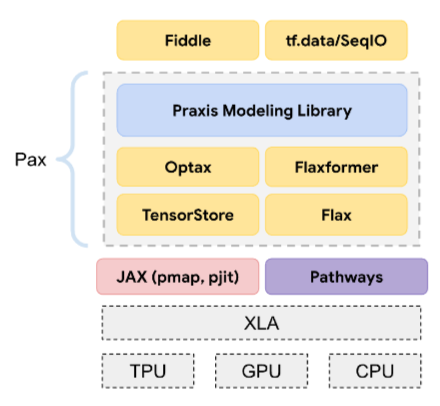
A programming framework designed for training large-scale
[**neural network**](https://developers.google.com/machine-learning/glossary#neural-network) [**models**](https://developers.google.com/machine-learning/glossary#model) so large
that they span multiple [**TPU**](https://developers.google.com/machine-learning/glossary#TPU)
[**accelerator chip**](https://developers.google.com/machine-learning/glossary#accelerator-chip) [**slices**](https://developers.google.com/machine-learning/glossary#TPU_slice)
or [**pods**](https://developers.google.com/machine-learning/glossary#TPU_Pod).
Pax is built on [**Flax**](https://developers.google.com/machine-learning/glossary#flax), which is built on [**JAX**](https://developers.google.com/machine-learning/glossary#JAX).
## PLM
#generativeAI
Abbreviation for [**pre-trained language model**](https://developers.google.com/machine-learning/glossary/generative#pre-trained-model).
## post-trained model
#generativeAI
Loosely-defined term that typically refers to a
[**pre-trained model**](https://developers.google.com/machine-learning/glossary/generative#pre-trained-model) that has gone through some
post-processing, such as one or more of the following:
- [**Distillation**](https://developers.google.com/machine-learning/glossary/generative#distillation)
- [**Fine-tuning**](https://developers.google.com/machine-learning/glossary/generative#fine-tuning)
- [**Instruction tuning**](https://developers.google.com/machine-learning/glossary/generative#instruction-tuning)
## pre-trained model
#generativeAI
Although this term could refer to any trained [**model**](https://developers.google.com/machine-learning/glossary#model) or
trained [**embedding vector**](https://developers.google.com/machine-learning/glossary#embedding_vector), pre-trained model now
typically refers to a trained [**large language model**](https://developers.google.com/machine-learning/glossary/generative#large-language-model)
or other form of trained [**generative AI**](https://developers.google.com/machine-learning/glossary/generative#generative-AI) model.
See also [**base model**](https://developers.google.com/machine-learning/glossary/generative#base-model) and
[**foundation model**](https://developers.google.com/machine-learning/glossary/generative#foundation-model).
## pre-training
#generativeAI
The initial [**training**](https://developers.google.com/machine-learning/glossary#training) of a model on a large
[**dataset**](https://developers.google.com/machine-learning/glossary#dataset). Some pre-trained models
are clumsy giants and must typically be refined through additional training.
For example, ML experts might pre-train a
[**large language model**](https://developers.google.com/machine-learning/glossary/generative#large-language-model) on a vast text dataset,
such as all the English pages in Wikipedia. Following pre-training, the
resulting model might be further refined through any of the following
techniques:
- [**distillation**](https://developers.google.com/machine-learning/glossary/generative#distillation)
- [**fine-tuning**](https://developers.google.com/machine-learning/glossary/generative#fine-tuning)
- [**instruction tuning**](https://developers.google.com/machine-learning/glossary/generative#instruction-tuning)
- [**parameter-efficient tuning**](https://developers.google.com/machine-learning/glossary/generative#parameter-efficient-tuning)
- [**prompt-tuning**](https://developers.google.com/machine-learning/glossary/generative#prompt-tuning)
## Pro
#generativeAI
A [**Gemini model**](https://developers.google.com/machine-learning/glossary/generative#Gemini-models) with fewer [**parameters**](https://developers.google.com/machine-learning/glossary#parameter)
than [**Ultra**](https://developers.google.com/machine-learning/glossary/generative#Ultra) but more parameters than [**Nano**](https://developers.google.com/machine-learning/glossary/generative#Nano). See
[Gemini Pro](https://deepmind.google/models/gemini/pro/)
for details.
## prompt
#generativeAI
Any text entered as input to a [**large language model**](https://developers.google.com/machine-learning/glossary/generative#large-language-model)
to condition the model to behave in a certain way. Prompts can be as short as a
phrase or arbitrarily long (for example, the entire text of a novel). Prompts
fall into multiple categories, including those shown in the following table:
| Prompt category | Example | Notes |
|---|---|---|
| Question | How fast can a pigeon fly? |
| Instruction | Write a funny poem about arbitrage. | A prompt that asks the large language model to *do* something. |
| Example | Translate Markdown code to HTML. For example: Markdown: \* list item HTML: \ \list item\ \ | The first sentence in this example prompt is an instruction. The remainder of the prompt is the example. |
| [**Role**](https://developers.google.com/machine-learning/glossary/generative#role-prompting) | Explain why gradient descent is used in machine learning training to a PhD in Physics. | The first part of the sentence is an instruction; the phrase "to a PhD in Physics" is the role portion. |
| Partial input for the model to complete | The Prime Minister of the United Kingdom lives at | A partial input prompt can either end abruptly (as this example does) or end with an underscore. |
A [**generative AI**](https://developers.google.com/machine-learning/glossary/generative#generative-AI) model can respond to a prompt with text,
code, images, [**embeddings**](https://developers.google.com/machine-learning/glossary#embedding_vector), videos...almost anything.
## prompt-based learning
#generativeAI
A capability of certain [**models**](https://developers.google.com/machine-learning/glossary#model) that enables them to adapt
their behavior in response to arbitrary text input ([**prompts**](https://developers.google.com/machine-learning/glossary/generative#prompt)).
In a typical prompt-based learning paradigm, a
[**large language model**](https://developers.google.com/machine-learning/glossary/generative#large-language-model) responds to a prompt by
generating text. For example, suppose a user enters the following prompt:
> Summarize Newton's Third Law of Motion.
A model capable of prompt-based learning isn't specifically trained to answer
the previous prompt. Rather, the model "knows" a lot of facts about physics,
a lot about general language rules, and a lot about what constitutes generally
useful answers. That knowledge is sufficient to provide a (hopefully) useful
answer. Additional human feedback ("That answer was too complicated." or
"What's a reaction?") enables some prompt-based learning systems to gradually
improve the usefulness of their answers.
## prompt design
#generativeAI
Synonym for [**prompt engineering**](https://developers.google.com/machine-learning/glossary/generative#prompt-engineering).
## prompt engineering
#generativeAI
The art of creating [**prompts**](https://developers.google.com/machine-learning/glossary/generative#prompt) that elicit the desired
[**responses**](https://developers.google.com/machine-learning/glossary/generative#response) from a
[**large language model**](https://developers.google.com/machine-learning/glossary/generative#large-language-model). Humans perform prompt
engineering. Writing well-structured prompts is an essential part of ensuring
useful responses from a large language model. Prompt engineering depends on
many factors, including:
- The dataset used to [**pre-train**](https://developers.google.com/machine-learning/glossary/generative#pre-training) and possibly [**fine-tune**](https://developers.google.com/machine-learning/glossary/generative#fine-tuning) the large language model.
- The [**temperature**](https://developers.google.com/machine-learning/glossary/generative#temperature) and other decoding parameters that the model uses to generate responses.
[**Prompt design**](https://developers.google.com/machine-learning/glossary/generative#prompt-design) is a synonym for prompt engineering.
See
[Introduction to prompt design](https://developers.generativeai.google/guide/prompt_best_practices)
for more details on writing helpful prompts.
## prompt set
#generativeAI
A group of [**prompts**](https://developers.google.com/machine-learning/glossary/generative#prompt) for [**evaluating**](https://developers.google.com/machine-learning/glossary/generative#evaluation) a
[**large language model**](https://developers.google.com/machine-learning/glossary/generative#large-language-model). For example, the following
illustration shows a prompt set consisting of three prompts:
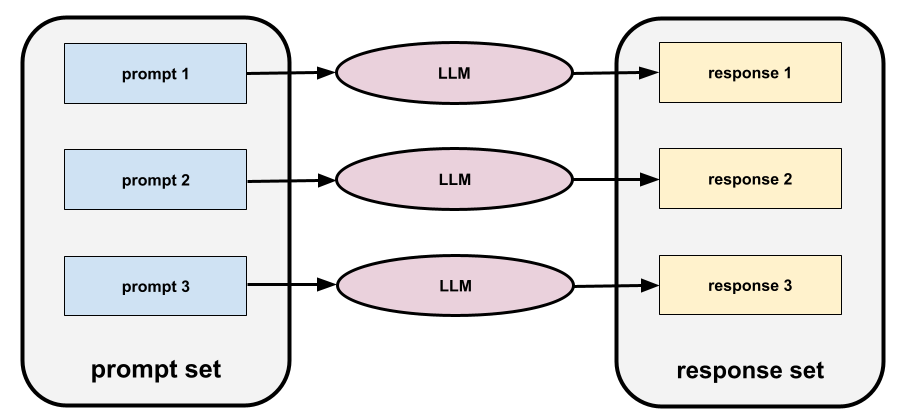
Good prompt sets consist of a sufficiently "wide" collection of prompts to
thoroughly evaluate the safety and helpfulness of a large language model.
See also [**response set**](https://developers.google.com/machine-learning/glossary/generative#response-set).
## prompt tuning
#generativeAI
A [**parameter efficient tuning**](https://developers.google.com/machine-learning/glossary/generative#parameter-efficient-tuning) mechanism
that learns a "prefix" that the system prepends to the
actual [**prompt**](https://developers.google.com/machine-learning/glossary/generative#prompt).
One variation of prompt tuning---sometimes called **prefix tuning** ---is to
prepend the prefix at *every layer* . In contrast, most prompt tuning only
adds a prefix to the [**input layer**](https://developers.google.com/machine-learning/glossary#input-layer).
#### Click the icon to learn more about prefixes.
For prompt tuning, the "prefix" (also known as a "soft prompt") is a
handful of learned, task-specific vectors prepended to the text token
embeddings from the actual prompt. The system learns the soft prompt by
freezing all other model parameters and fine-tuning on a specific task.
*** ** * ** ***
## R
## reference text
#generativeAI
An expert's response to a [**prompt**](https://developers.google.com/machine-learning/glossary/generative#prompt). For example, given the
following prompt:
> Translate the question "What is your name?" from English to French.
An expert's response might be:
> Comment vous appelez-vous?
Various metrics (such as [**ROUGE**](https://developers.google.com/machine-learning/glossary#ROUGE)) measure the degree to which the
reference text matches an ML model's [**generated text**](https://developers.google.com/machine-learning/glossary/generative#generated-text).
> [!NOTE]
> **Note:** The expert is typically a human but could be an ML model.
## reflection
#generativeAI #agent
A strategy for improving the quality of an
[**agentic workflow**](https://developers.google.com/machine-learning/glossary/generative#agentic-workflow) by examining (reflecting on) a
step's output before passing that output to the next step.
The examiner is often the same [**LLM**](https://developers.google.com/machine-learning/glossary/generative#LLM) that generated the response
(though it could be a different LLM).
How could the same LLM that generated a response be a fair judge of its
own response? The "trick" is to put the LLM in a critical (reflective)
mindset. This process is analogous to a writer who uses a creative
mindset to write a first draft and then switches to a critical mindset to
edit it.
For example, imagine an agentic workflow whose first step is to create
text for coffee mugs. The prompt for this step might be:
> You are a creative. Generate humorous, original text of less than 50
> characters suitable for a coffee mug.
Now imagine the following reflective prompt:
> You are a coffee drinker. Would you find the preceding response humorous?
The workflow might then only pass text that receives a high reflection score
to the next stage.
## Reinforcement Learning from Human Feedback (RLHF)
#generativeAI
Using feedback from human raters to improve the quality of a model's
[**responses**](https://developers.google.com/machine-learning/glossary/generative#response). For example, an RLHF mechanism can ask users to
rate the quality of a model's response with a 👍 or 👎 emoji. The system
can then adjust its future responses based on that feedback.
## response
#generativeAI
The text, images, audio, or video that a [**generative AI**](https://developers.google.com/machine-learning/glossary/generative#generative-AI)
model [**infers**](https://developers.google.com/machine-learning/glossary/generative#inference). In other words, a [**prompt**](https://developers.google.com/machine-learning/glossary/generative#prompt) is
the *input* to a generative AI model and the response is the *output*.
## response set
#generativeAI
The collection of [**responses**](https://developers.google.com/machine-learning/glossary/generative#response) a
[**large language model**](https://developers.google.com/machine-learning/glossary/generative#large-language-model) returns to an input
[**prompt set**](https://developers.google.com/machine-learning/glossary/generative#prompt-set).
## role prompting
#generativeAI
A [**prompt**](https://developers.google.com/machine-learning/glossary/generative#prompt), typically beginning with the pronoun **you** , that
tells a [**generative AI**](https://developers.google.com/machine-learning/glossary/generative#generative-AI) model to pretend to be a certain
person or a certain role when generating the [**response**](https://developers.google.com/machine-learning/glossary/generative#response).
Role prompting can help a generative AI model get into the right "mindset"
in order to generate a more useful response. For example, any of the
following role prompts might be appropriate depending on the kind of
response you are seeking:
> You have a PhD in computer science.
> You are a software engineer who enjoys giving patient explanations about
> Python to new programming students.
> You are an action hero with a very particular set of programming skills.
> Assure me that you will find a particular item in a Python list.
## S
## soft prompt tuning
#generativeAI
A technique for tuning a [**large language model**](https://developers.google.com/machine-learning/glossary/generative#large-language-model)
for a particular task, without resource intensive
[**fine-tuning**](https://developers.google.com/machine-learning/glossary/generative#fine-tuning). Instead of retraining all the
[**weights**](https://developers.google.com/machine-learning/glossary#weight) in the model, soft prompt tuning
automatically adjusts a [**prompt**](https://developers.google.com/machine-learning/glossary/generative#prompt) to achieve the same goal.
Given a textual prompt, soft prompt tuning
typically appends additional token embeddings to the prompt and uses
backpropagation to optimize the input.
A "hard" prompt contains actual tokens instead of token embeddings.
## specificational coding
#generativeAI
The process of writing and maintaining a file in a human language (for example,
English) that describes software. You can then tell a generative AI model or
another software engineer to create the software that fulfills that description.
Automatically-generated code generally requires iteration. In specificational
coding, you iterate on the description file. By contrast, in
[**conversational coding**](https://developers.google.com/machine-learning/glossary/generative#conversational-coding), you iterate within the
prompt box. In practice, automatic code generation sometimes involves a
combination of *both* specificational coding and conversational coding.
## T
## temperature
#generativeAI
A [**hyperparameter**](https://developers.google.com/machine-learning/glossary#hyperparameter) that controls the degree of randomness
of a model's output. Higher temperatures result in more random output,
while lower temperatures result in less random output.
Choosing the best temperature depends on the specific application and
or string values.
## U
## Ultra
#generativeAI
The [**Gemini model**](https://developers.google.com/machine-learning/glossary/generative#Gemini-models) with the most
[**parameters**](https://developers.google.com/machine-learning/glossary#parameter).
See [Gemini Ultra](https://deepmind.google/models/gemini/ultra/)
for details.
See also [**Pro**](https://developers.google.com/machine-learning/glossary/generative#Pro) and [**Nano**](https://developers.google.com/machine-learning/glossary/generative#Nano).
## V
## Vertex
#GoogleCloud #generativeAI Google Cloud's platform for AI and machine learning. Vertex provides tools and infrastructure for building, deploying, and managing AI applications, including access to [**Gemini**](https://developers.google.com/machine-learning/glossary/generative#Gemini) models.
## vibe coding
#generativeAI
Prompting a generative AI model to create software. That is, your prompts
describe the software's purpose and features, which a generative AI model
translates into source code. The generated code doesn't always match your
intentions, so vibe coding usually requires iteration.
[Andrej Karpathy](https://wikipedia.org/wiki/Andrej_Karpathy) coined the term
vibe coding in this [X post](https://x.com/karpathy/status/1886192184808149383).
In the X post, Karpathy describes it as "a new kind of coding...where you fully
give in to the vibes..." So, the term originally implied an intentionally loose
approach to creating software in which you might not even examine the generated
code. However, the term has rapidly evolved in many circles to now mean *any*
form of AI-generated coding.
For a more detailed description of vibe coding, see
[What is vibe coding?](https://cloud.google.com/discover/what-is-vibe-coding).
In addition, compare and contrast vibe coding with:
- [**specificational coding**](https://developers.google.com/machine-learning/glossary/generative#specificational-coding)
- [**conversational coding**](https://developers.google.com/machine-learning/glossary/generative#conversational-coding)
## Z
## zero-shot prompting
#generativeAI
A [**prompt**](https://developers.google.com/machine-learning/glossary/generative#prompt) that does *not* provide an example of how you want
the [**large language model**](https://developers.google.com/machine-learning/glossary/generative#large-language-model) to respond. For example:
| Parts of one prompt | Notes |
|---|---|
| What is the official currency of the specified country? | The question you want the LLM to answer. |
| India: | The actual query. |
The large language model might respond with any of the following:
- Rupee
- INR
- ₹
- Indian rupee
- The rupee
- The Indian rupee
All of the answers are correct, though you might prefer a particular format.
Compare and contrast **zero-shot prompting** with the following terms:
- [**one-shot prompting**](https://developers.google.com/machine-learning/glossary/generative#one-shot-prompting)
- [**few-shot prompting**](https://developers.google.com/machine-learning/glossary/generative#few-shot-prompting)