The following questions help you solidify your understanding of core ML concepts.
ভবিষ্যদ্বাণীমূলক শক্তি
Supervised ML models are trained using datasets with labeled examples. The model learns how to predict the label from the features. However, not every feature in a dataset has predictive power. In some instances, only a few features act as predictors of the label. In the dataset below, use price as the label and the remaining columns as the features.

Which three features do you think are likely the greatest predictors for a car's price?
মডেল তৈরি করুন, বছর, মাইল।
একটি গাড়ির দামের জন্য তার তৈরি/মডেল, বছর এবং মাইল সম্ভবত সবচেয়ে শক্তিশালী ভবিষ্যদ্বাণীকারী হতে পারে।
রঙ, উচ্চতা, মডেল তৈরি করুন।
একটি গাড়ির উচ্চতা এবং রঙ গাড়ির দামের জন্য শক্তিশালী ভবিষ্যদ্বাণীকারী নয়।
মাইলস, গিয়ারবক্স, মেক_মডেল।
গিয়ারবক্স দামের প্রধান ভবিষ্যদ্বাণীকারী নয়।
টায়ারের_আকার, চাকার_বেস, বছর।
Tire size and wheel base aren't strong predictors for a car's price.
তত্ত্বাবধানে এবং তত্ত্বাবধানহীন শিক্ষা
Based on the problem, you'll use either a supervised or unsupervised approach. For example, if you know beforehand the value or category you want to predict, you'd use supervised learning. However, if you wanted to learn if your dataset contains any segmentations or groupings of related examples, you'd use unsupervised learning.
ধরুন আপনার কাছে একটি অনলাইন শপিং ওয়েবসাইটের ব্যবহারকারীদের একটি ডেটাসেট আছে এবং এতে নিম্নলিখিত কলামগুলি রয়েছে:

If you wanted to understand the types of users that visit the site, would you use supervised or unsupervised learning?
তত্ত্বাবধানহীন শিক্ষা।
Because we want the model to cluster groups of related customers, we'd use unsupervised learning. After the model clustered the users, we'd create our own names for each cluster, for example, "discount seekers," "deal hunters," "surfers," "loyal," and "wanderers."
Supervised learning because I'm trying to predict which class a user belongs to.
In supervised learning, the dataset must contain the label you're trying to predict. In the dataset, there is no label that refers to a category of user.
Suppose you had an energy usage dataset for homes with the following columns:
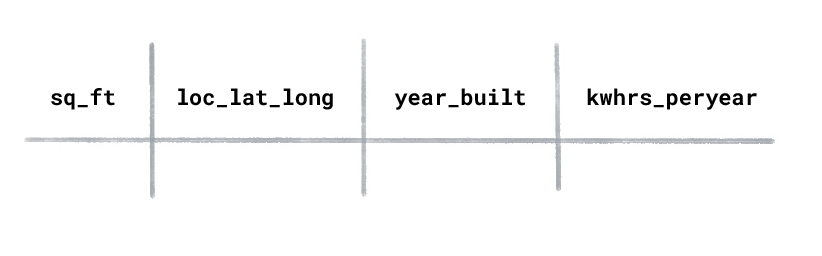
একটি নবনির্মিত বাড়ির জন্য বছরে ব্যবহৃত কিলোওয়াট ঘন্টা পূর্বাভাস দেওয়ার জন্য আপনি কোন ধরণের ML ব্যবহার করবেন?
তত্ত্বাবধানে পড়াশুনা।
Supervised learning trains on labeled examples. In this dataset "kilowatt hours used per year” would be the label because this is the value you want the model to predict. The features would be "square footage,” "location,” and "year built.”
তত্ত্বাবধানহীন শিক্ষা।
Unsupervised learning uses unlabeled examples. In this example, "kilowatt hours used per year” would be the label because this is the value you want the model to predict.
Suppose you had a flight dataset with the following columns:

If you wanted to predict the cost of an airplane ticket, would you use regression or classification?
রিগ্রেশন
একটি রিগ্রেশন মডেলের আউটপুট হল একটি সংখ্যাসূচক মান।
শ্রেণীবিভাগ
A classification model's output is a discrete value, normally a word. In this case, the cost of an airplane ticket is a numeric value.
Based on the dataset, could you train a classification model to classify the cost of an airplane ticket as "high," "average," or "low"?
Yes, but we'd first need to convert the numeric values in the airplane_ticket_cost column to categorical values.
It's possible to create a classification model from the dataset. You would do something like the following:
- Find the average cost of a ticket from the departure airport to the destination airport.
- Determine the thresholds that would constitute "high," "average," and "low".
- Compare the predicted cost to the thresholds and output the category the value falls within.
No. It's not possible to create a classification model. The airplane_ticket_cost values are numeric not categorical.
With a little bit of work, you could create a classification model.
No. Classification models only predict two categories, like spam or not_spam . This model would need to predict three categories.
Classification models can predict multiple categories. They're called multiclass classification models.
প্রশিক্ষণ এবং মূল্যায়ন
After we've trained a model, we evaluate it by using a dataset with labeled examples and compare the model's predicted value to the label's actual value.
প্রশ্নের জন্য দুটি সেরা উত্তর নির্বাচন করুন।
যদি মডেলের ভবিষ্যদ্বাণীগুলি অনেক দূরে থাকে, তাহলে সেগুলিকে আরও ভালো করার জন্য আপনি কী করতে পারেন?
Retrain the model, but use only the features you believe have the strongest predictive power for the label.
Retraining the model with fewer features, but that have more predictive power, can produce a model that makes better predictions.
You can't fix a model whose predictions are far off.
যে মডেলের ভবিষ্যদ্বাণী ভুল, তাকে ঠিক করা সম্ভব। বেশিরভাগ মডেলেরই কার্যকর ভবিষ্যদ্বাণী না করা পর্যন্ত একাধিক প্রশিক্ষণের প্রয়োজন হয়।
Retrain the model using a larger and more diverse dataset.
Models trained on datasets with more examples and a wider range of values can produce better predictions because the model has a better generalized solution for the relationship between the features and the label.
একটি ভিন্ন প্রশিক্ষণ পদ্ধতি চেষ্টা করুন। উদাহরণস্বরূপ, যদি আপনি একটি তত্ত্বাবধানে থাকা পদ্ধতি ব্যবহার করেন, তাহলে একটি অতত্ত্বাবধানে থাকা পদ্ধতি চেষ্টা করুন।
A different training approach would not produce better predictions.
You're now ready to take the next step in your ML journey:
Machine Learning Crash Course . If you're ready for an in-depth, hands-on approach to learning more about ML.
Problem Framing . If you're looking for a field-tested approach for creating ML models and avoiding common pitfalls.
People + AI Guidebook . If you're looking for practical guidance for designing human-centered AI products.
