The primary components of the Search Ads 360 Reporting API are *resources* and
*services*. A resource represents a Search Ads 360 entity and you use a service
to retrieve Search Ads 360 entities.
## Object hierarchy
A Search Ads 360 account is a hierarchy of objects.
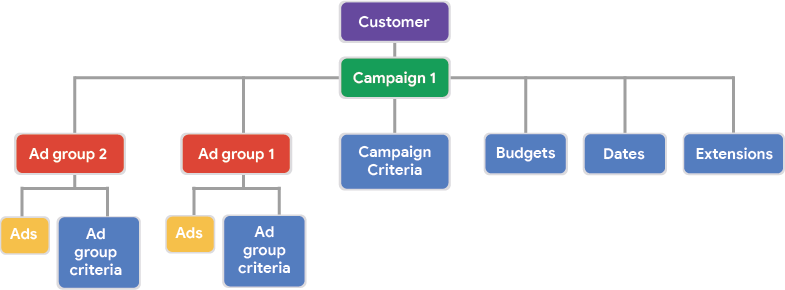
- The top-level resource of an account is the [customer](https://developers.google.com/search-ads/reporting/api/reference/fields/v0/customer).
- Each account contains one or more active [campaigns](https://developers.google.com/search-ads/reporting/api/reference/fields/v0/campaign).
- Each `Campaign` contains one or more [ad groups](https://developers.google.com/search-ads/reporting/api/reference/fields/v0/ad_group) that
group your ads into logical collections.
- Each `AdGroup` contains one or more [ad group ads](https://developers.google.com/search-ads/reporting/api/reference/fields/v0/ad_group_ad).
- You can attach one or more
[`AdGroupCriterion`](https://developers.google.com/search-ads/reporting/api/reference/fields/v0/ad_group_criterion) or
[`CampaignCriterion`](https://developers.google.com/search-ads/reporting/api/reference/fields/v0/campaign_criterion) to an ad group or
campaign. Criteria define how ads are triggered.
- There are many [criterion types](), such as, keywords, age ranges, and locations. Criteria defined at the campaign level affect all other resources within the campaign. You can also specify campaign-wide budgets and dates.
## Resources
Resources represent the entities in your Search Ads 360 account. Example
resources include [`Customer`](https://developers.google.com/search-ads/reporting/api/reference/fields/v0/customer),
[`Campaign`](https://developers.google.com/search-ads/reporting/api/reference/fields/v0/campaign), and [`AdGroup`](https://developers.google.com/search-ads/reporting/api/reference/fields/v0/ad_group).
### Object IDs
Every object in Search Ads 360 is identified by its own ID. Some IDs are
globally unique, that is, across all Search Ads 360 accounts, while others are
unique only within a confined scope.
| Object ID uniqueness scope ||
|---|---|
| Budget ID | Global |
| Campaign ID | Global |
| AdGroup ID | Global |
| Ad ID | Ad Group
Each `AdGroupId` / `AdId` pair is globally unique. |
| AdGroupCriterion ID | Ad Group
Each `AdGroupId` / `CriterionId` pair is globally unique. |
| CampaignCriterion ID | Campaign
Each `CampaignId` / `CriterionId` pair is globally unique. |
| Ad Extensions | Campaign
Each `CampaignId` / `AdExtensionId` pair is globally unique. |
| Feed ID | Global |
| Feed Item ID | Global |
| Feed Attribute ID | Feed |
| Feed Mapping ID | Global |
| Label ID | Global |
| UserList ID | Global |
These ID rules can be useful when designing local storage for your Search Ads
360 objects.
### Object types
Some objects can be used for multiple entity types. If this is the case, the
object contains a `type` field that describes its contents. For example,
[`AdGroupAd`](https://developers.google.com/search-ads/reporting/api/reference/fields/v0/ad_group_ad) can refer to a text ad, hotel ad, or local
ad. You can access the type value through the
[`AdGroupAd.ad.type`](https://developers.google.com/search-ads/reporting/api/reference/fields/v0/ad_group_ad#ad_group_ad.ad.type) field. Its
value is returned in the
[`AdType`](https://developers.google.com/search-ads/reporting/api/reference/rpc/google.ads.searchads360.v0.enums#adtypeenum) enum.
### Resource names
Each resource is uniquely identified by a `resource_name` string that
concatenates the resource and its parents into a path.
Campaign resource names, for example, have the form:
```
customers/CUSTOMER_ID/campaigns/CAMPAIGN_ID
```
A campaign with ID `987654` in the Search Ads 360 account with customer ID
`1234567`, has the `resource_name`:
```
customers/1234567/campaigns/987654
```
## Services
Services let you retrieve your Search Ads 360 entities and metadata. There are
three service types:
Search service
: [`SearchAds360Service`](https://developers.google.com/search-ads/reporting/api/reference/rpc/google.ads.searchads360.v0.services#searchads360service)
is the single, unified service for retrieving all resource objects and
performance statistics. It provides two methods: *`Search`* and
*`SearchStream`* . Both methods require a query that specifies the resource
to query, the resource attributes and performance metrics to retrieve, the
predicates to use for filtering the request, and the segments to use to
further break down performance statistics. See
[Create search reports](https://developers.google.com/search-ads/reporting/concepts/search-reports) and
[Search Ads 360 Query Language](https://developers.google.com/search-ads/reporting/query/query-language) for more
information.
Field service
: [`SearchAds360FieldService`](https://developers.google.com/search-ads/reporting/api/reference/rpc/google.ads.searchads360.v0.services#searchads360fieldservice)
retrieves metadata about resources, such as, the available attributes for a
resource and its data type. You can request the catalog for resources,
resource fields, segmentation keys, and metrics available in the
`SearchAds360Service` search methods. See
[Retrieve resource metadata](https://developers.google.com/search-ads/reporting/concepts/field-service) to learn more.
Entity-specific services
: These services provide a `GET` request method that retrieves a single
resource instance. This is useful for examining the structure of a resource.
Examples of entity-specific services include:
- [CustomColumnService](https://developers.google.com/search-ads/reporting/api/reference/rpc/google.ads.searchads360.v0.services#customcolumnservice) that returns the requested custom column in full detail.