> [!NOTE]
> **Note:** You don't need to register or request access to use Promotions tab annotations. For troubleshooting steps, see the [Troubleshoot](https://developers.google.com/workspace/gmail/promotab/troubleshooting.md.txt) guide, or email questions to [p-Promo-Outreach@google.com](mailto:p-Promo-Outreach@google.com).
Email annotations bring email messages in the Promotions tab to life with
images, deals, promo codes, and expiration dates.
When you annotate emails, Gmail users can view and interact with your
promotions directly from their inbox. From the Promotions tab, users can click
annotated text or images to learn more about a promotion without opening the
email.
This document explains how to annotate emails. Email annotations use email
markup---structured data in your email's HTML that Gmail reads to
generate rich previews, deal badges, and deal cards in the Promotions tab using
[JSON-LD](https://developers.google.com/workspace/gmail/markup/reference/formats/json-ld.md.txt) and
[Microdata](https://developers.google.com/workspace/gmail/markup/reference/formats/microdata.md.txt). To learn more
about email markup, review the [Get
started](https://developers.google.com/workspace/gmail/markup/getting-started) guide. For a list of markup
fields that you can use in email annotations, see the [Email promotions
reference](https://developers.google.com/workspace/gmail/promotab/reference) documentation.
## Types of email annotations
You can annotate emails to display the following features in the Promotions tab:
- [Product carousel](https://developers.google.com/workspace/gmail/promotab/build-email-annotations.md.txt#product-carousel): Displays two to ten clickable product image cards using multiple [`PromotionCard`](https://developers.google.com/workspace/gmail/promotab/reference.md.txt#promotioncard) objects.
- [Single image preview](https://developers.google.com/workspace/gmail/promotab/build-email-annotations.md.txt#single-image-preview): Displays one clickable product or promotional image card using a single [`PromotionCard`](https://developers.google.com/workspace/gmail/promotab/reference.md.txt#promotioncard) object.
- [Deal annotation](https://developers.google.com/workspace/gmail/promotab/build-email-annotations.md.txt#deal-annotation): Displays a promotional badge, discount code, or expiration date next to the email subject line using a [`DiscountOffer`](https://developers.google.com/workspace/gmail/promotab/reference.md.txt#discountoffer) object.
- [Deal card](https://developers.google.com/workspace/gmail/promotab/build-email-annotations.md.txt#deal-card): Displays a visual summary card of your offer with an action link in the Promotions tab and at the top of the opened email using a [`DiscountOffer`](https://developers.google.com/workspace/gmail/promotab/reference.md.txt#discountoffer) object with an offer URL.
You can use a deal annotation or deal card on its own, or combine a
`DiscountOffer` object with one or more `PromotionCard` objects in the same
email to display both a deal badge and image previews. Use the following
properties to specify prices, percentage discounts, and discount or coupon codes
in your markup:
- **Item price and discounted price** : Use the `price`, `priceCurrency`, and `discountValue` properties in a [`PromotionCard`](https://developers.google.com/workspace/gmail/promotab/reference.md.txt#promotioncard) object. `discountValue` is the numeric currency amount that Gmail subtracts from `price`.
- **Percentage discount** : Use the `description` property, such as `"20%
off"`, in a [`DiscountOffer`](https://developers.google.com/workspace/gmail/promotab/reference#discountoffer) object.
- **Discount or coupon code** : Use the `discountCode` property, such as `"20TODAY"`, in a [`DiscountOffer`](https://developers.google.com/workspace/gmail/promotab/reference.md.txt#discountoffer) object.
Annotations might not be visible to all recipients. They display only in the
Promotions tab for consumer Gmail accounts, and visibility
depends on user account settings, sender quality filters, frequency limits, and
active offer dates. For details, see the
[Troubleshoot](https://developers.google.com/workspace/gmail/promotab/troubleshooting.md.txt) guide and
[FAQ](https://developers.google.com/workspace/gmail/promotab/faq.md.txt).
> [!NOTE]
> **Note:** `PromotionCard` and `DiscountOffer` are Gmail custom extensions to the `http://schema.org/` vocabulary. Keep `"@context":
> "http://schema.org/"` in JSON-LD and `itemtype="http://schema.org/..."` in Microdata exactly as shown in the following examples, even though visiting those schema URLs in a browser returns a `404` page.
## Create a product carousel
Product carousels display multiple image previews for a promotion, such as the
following:
 **Figure 1.** A promotional email with a product carousel of three sock deals showing images, headlines, and discounted prices
A product carousel requires at least two and up to ten image previews. Each
image in the carousel must have a unique URL and use the same aspect ratio.
Figure 1 shows three image cards with headlines and discounted prices. To also
display a deal badge above your product carousel, include a
[`DiscountOffer`](https://developers.google.com/workspace/gmail/promotab/reference.md.txt#discountoffer) object
alongside your
[`PromotionCard`](https://developers.google.com/workspace/gmail/promotab/reference.md.txt#promotioncard) objects, as
shown in the [product carousel with deal badge](https://developers.google.com/workspace/gmail/promotab/build-email-annotations.md.txt#product-carousel-example)
example.
To create a product carousel:
1. In your marketing email platform, create an email and open the email's HTML editor.
2. In the `head` section, add your markup. For each image in your product
carousel, add a
[`PromotionCard`](https://developers.google.com/workspace/gmail/promotab/reference.md.txt#promotioncard) object:
### JSON-LD
```html
```
### Microdata
```html
```
For each `PromotionCard` object, replace the following placeholders. For
optional properties, either provide a valid value or remove the property
from your markup.
**Required properties:**
- `IMAGE_URL`: The URL to your image in PNG, JPG,
or JPEG format, such as `https://www.example.com/image1.png`. The
supported aspect ratios for product carousels are 4:5, 1:1, and 1.91:1.
Every card in a product carousel must use a unique image URL and share
the same aspect ratio.
- `PROMO_URL`: The landing page URL for the
product or promotion. When users click the image from the Promotions
tab, they visit this URL.
**Optional properties:**
- `HEADLINE`: A one- or two-line description of
the product or promotion that displays under the preview image. If you
include `headline` on a card in a product carousel, you must include
`headline` on every card in the carousel, or headlines don't display on
any card.
- `PRICE`: The numeric price of the item as a
positive number without a currency symbol, such as `100` or `24.99`. If
you include `price`, you must also include `priceCurrency`. In a
product carousel, you must include `price` and `priceCurrency` on every
card in the carousel for prices to display on any card.
- `PRICE_CURRENCY`: The currency of the price in
three-letter [ISO 4217](https://en.wikipedia.org/wiki/ISO_4217) format,
such as `USD`. You must include `priceCurrency` whenever you set
`price`; it determines the currency symbol that Gmail
displays with `price`. If you omit `price`, Gmail
ignores `priceCurrency`.
- `DISCOUNT_VALUE`: The numeric currency amount
that Gmail subtracts from `price` to calculate and
display an adjusted price next to the crossed-out original price. To
use `discountValue`, you must also provide `price` and `priceCurrency`,
and `discountValue` must be a positive number less than or equal to
`price`. Don't enter a percentage discount or coupon code in this
field. To display a percentage discount or discount code, add a
[`DiscountOffer`](https://developers.google.com/workspace/gmail/promotab/reference.md.txt#discountoffer)
object and set its `description` and `discountCode` properties, as
shown in the [product carousel with a deal badge
example](https://developers.google.com/workspace/gmail/promotab/build-email-annotations#product-carousel-example).
For example, if `price` is `100`, `priceCurrency` is `USD`, and
`discountValue` is `25`, the card displays `$75` next to a crossed-out
`$100`.
- `POSITION`: A unique positive integer, such as
`1` or `2`, that specifies the display order of the card in the
carousel.
3. In the `body` tag, write the message for your email.
4. Before sending your campaign, validate your code and see a
[preview](https://developers.google.com/workspace/gmail/promotab/preview.md.txt) of how your product carousel
looks.
### Example: Product carousel with a deal badge
The following example combines a `DiscountOffer` deal annotation with three
`PromotionCard` objects to display a deal badge, promo code, and a three-card
product carousel. When testing this example, set `availabilityEnds` to a future
date and time so active-offer features render:
### JSON-LD
```html
Use code 20TODAY for 20% off all socks!
```
### Microdata
```html
Use code 20TODAY for 20% off all socks!
```
## Create a single image preview
Single image preview annotations display one image to showcase an important
product or promotion in the Gmail Promotions tab, such as the
following:
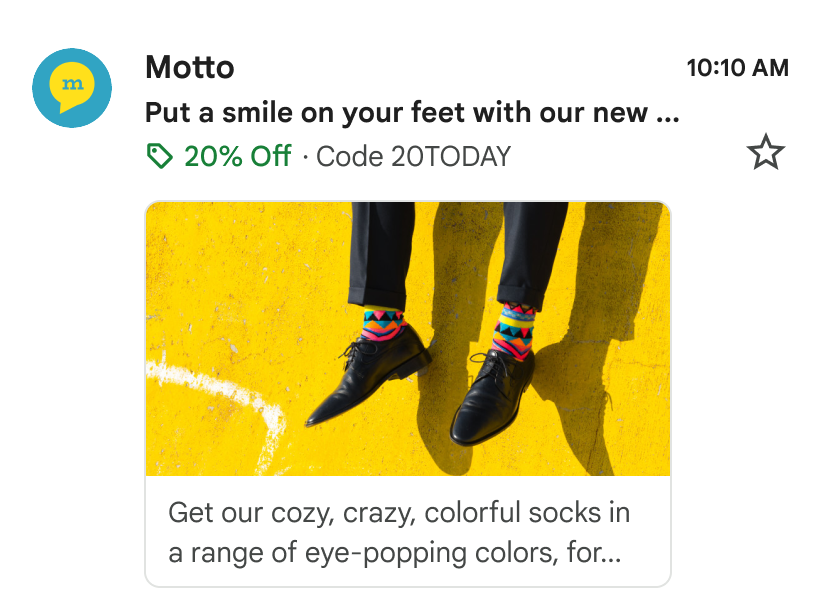 **Figure 2.** A promotional email with a single image preview of socks and shoes, a headline, a 20% off badge, and the promo code 20TODAY
> [!NOTE]
> **Note:** Figure 2 combines two annotations in the same email: a [deal
> annotation](https://developers.google.com/workspace/gmail/promotab/build-email-annotations#deal-annotation) built with `DiscountOffer` and a single image preview built with `PromotionCard`. To display a percentage discount such as **20% off** or a coupon code such as **20TODAY** , add a `DiscountOffer` object to your markup and set its `description` and `discountCode` properties. To display an item price and discounted price on the image card, set `price`, `priceCurrency`, and `discountValue` in the `PromotionCard` object. For the complete markup that produces this layout, see the [single image preview with a deal badge](https://developers.google.com/workspace/gmail/promotab/build-email-annotations.md.txt#single-image-example) example.
You can use a single `PromotionCard` object to display one image. All
recipients must receive the same image and image URL. For more information, see
the [FAQ](https://developers.google.com/workspace/gmail/promotab/faq.md.txt).
To create a single image preview:
1. In your marketing email platform, create an email and open the email's HTML editor.
2. In the `head` section, add a
[`PromotionCard`](https://developers.google.com/workspace/gmail/promotab/reference.md.txt#promotioncard)
object:
### JSON-LD
```html
```
### Microdata
```html
```
Replace the following placeholders. For optional properties, either provide
a valid value or remove the property from your markup.
**Required properties:**
- `IMAGE_URL`: The URL for the preview image in
PNG, JPG, or JPEG format, such as `https://www.example.com/image.png`.
The required aspect ratio for a single image preview is 1.91:1.
- `PROMO_URL`: The URL that directs users to the
promotion when they click the preview image.
**Optional properties:**
- `HEADLINE`: A one- or two-line description of
the promotion that displays under the preview image.
- `PRICE`: The numeric price of the item as a
positive number without a currency symbol, such as `100` or `49.95`. If
you include `price`, you must also include `priceCurrency`.
- `PRICE_CURRENCY`: The currency of the price in
three-letter [ISO 4217](https://en.wikipedia.org/wiki/ISO_4217) format,
such as `USD`. You must include `priceCurrency` whenever you set
`price`; it determines the currency symbol that Gmail
displays with `price`. If you omit `price`, Gmail
ignores `priceCurrency`.
- `DISCOUNT_VALUE`: The numeric currency amount
that Gmail subtracts from `price` to calculate and
display an adjusted price next to the crossed-out original price. To
use `discountValue`, you must also provide `price` and `priceCurrency`,
and `discountValue` must be a positive number less than or equal to
`price`. Don't enter a percentage discount or coupon code in this
field. To display a percentage discount or discount code, add a
[`DiscountOffer`](https://developers.google.com/workspace/gmail/promotab/reference.md.txt#discountoffer)
object and set its `description` and `discountCode` properties, as
shown in the [single image preview with a deal badge
example](https://developers.google.com/workspace/gmail/promotab/build-email-annotations#single-image-example).
For example, if `price` is `100`, `priceCurrency` is `USD`, and
`discountValue` is `20`, the card displays `$80` next to a crossed-out
`$100`.
3. In the `body` tag, write the message for your email.
4. Before sending your campaign, validate your code and see a
[preview](https://developers.google.com/workspace/gmail/promotab/preview.md.txt) of how your single image
preview looks.
### Example: Single image preview with a deal badge
The following example combines a `DiscountOffer` object and a `PromotionCard`
object to display a **20% off** deal badge, the promo code **20TODAY** , and a
single image preview with a discounted price. Keep `availabilityEnds` set to a
future date and time when testing:
### JSON-LD
```html
Save 20% on lightweight running shoes with code 20TODAY.
```
### Microdata
```html
Save 20% on lightweight running shoes with code 20TODAY.
```
## Create a deal annotation
Make your email stand out with a deal annotation. This feature adds a
promotional badge directly to your email in the inbox, calling out key
information such as a discount offer, promo code, or expiration date right next
to your subject line, as shown in the
[deal annotation](https://developers.google.com/workspace/gmail/promotab/build-email-annotations.md.txt#deal-annotation-example) example.
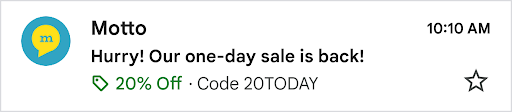 **Figure 3.** A promotional email with a deal annotation showing a 20% off badge and the promo code 20TODAY
To enable deal annotations, follow these steps:
1. **Add the schema to your email's HTML** : In your marketing email platform,
open the HTML editor for your campaign. In the `head` section, add a
[`DiscountOffer`](https://developers.google.com/workspace/gmail/promotab/reference.md.txt#discountoffer)
object with the following structure:
### JSON-LD
```html
```
### Microdata
```html
```
2. **Customize the deal annotation properties**: Update the values in your
markup to match your promotion. Remove any optional properties that you
don't use.
**Required values:** Include **at least one** of `description`,
`discountCode`, or `availabilityEnds` to generate a deal annotation.
- `DESCRIPTION`: A concise summary of your offer,
up to 45 characters. For offer validation, state a quantifiable
discount in English using one of the following formats:
- **Percentage off** : A percentage paired with `off` or `save`, such as `20% off`, `50% off sitewide`, or `Save 20%`
- **Amount off** : A currency symbol such as `$`, `£`, or `€` and a numeric amount without thousands commas, paired with `off` or `save`, such as `$25 off` or `Save up to £2000`
- **Buy one, get one** : A phrase such as `Buy 1 get 1 free`, `Buy 2 get 1 50% off`, or `BOGO`
- **Free shipping** : A phrase such as `Free shipping`, `Free delivery`, or `$0 delivery fee`
- `DISCOUNT_CODE`: The promo code that a user
applies at checkout. The code must be 4 to 20 characters long and
contain only uppercase letters from `A` to `Z` and numbers from `0` to
`9` with no spaces or special characters, such as `20TODAY`.
- `END_DATE_TIME`: The end date and time of the
promotion in
[ISO 8601](https://support.google.com/merchants/answer/7055760) format,
`YYYY-MM-DDTHH:MM:SS±HH:MM`, including seconds and a timezone offset
with a colon, such as `2028-09-23T18:44:37-07:00`. Set a future date and
time when testing so expiration labels and active-offer features render.
**Optional value:**
- `START_DATE_TIME`: The start date and time of the promotion in [ISO 8601](https://support.google.com/merchants/answer/7055760) format, `YYYY-MM-DDTHH:MM:SS±HH:MM`, such as `2028-08-24T18:44:37-07:00`.
3. **Write your email message** : In the `` tag, write the message and
design the layout for your email as you normally would.
4. **Validate and preview your deal annotation** : Before sending your campaign,
validate your code and see a [preview](https://developers.google.com/workspace/gmail/promotab/preview.md.txt)
of how your deal annotation looks.
### Example: Deal annotation
The following example creates a deal annotation badge for `20% off` with promo
code `20TODAY`. Keep `availabilityEnds` set to a future date and time when
testing:
### JSON-LD
```html
Take 20% off your order with code 20TODAY.
```
### Microdata
```html
Take 20% off your order with code 20TODAY.
```
## Create a deal card
Deal cards are visual summaries of your promotions that Gmail
generates. They can appear in the Promotions tab and within the email, giving
your offers maximum visibility, as shown in the [deal card](https://developers.google.com/workspace/gmail/promotab/build-email-annotations.md.txt#deal-card-example)
example.
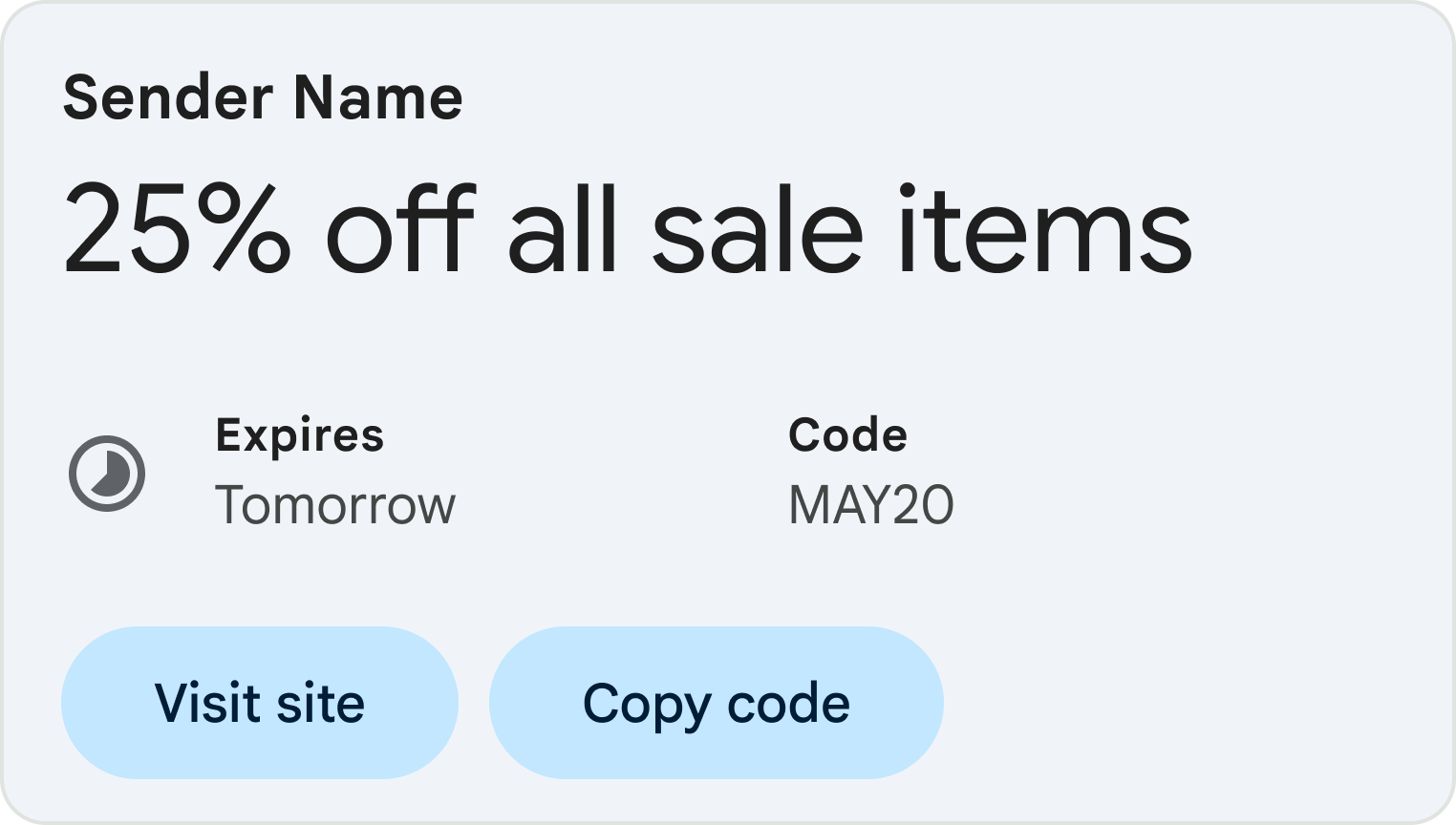 **Figure 4.** A deal card for 25% off all sale items with an expiration notice, the promo code MAY20, and action buttons
To enable deal cards, follow these steps:
1. **Add the schema to your email's HTML** : In your marketing email platform,
open the HTML editor for your campaign. In the `head` section, add a
[`DiscountOffer`](https://developers.google.com/workspace/gmail/promotab/reference.md.txt#discountoffer)
object with the following structure:
### JSON-LD
```html
```
### Microdata
```html
```
2. **Customize the deal card properties**: Update the values in your markup to
match your promotion. Remove any optional properties that you don't use.
**Required values:**
- `DESCRIPTION`: A concise summary of your offer,
up to 45 characters. Format the description using one of the supported
English discount patterns listed in
[Create a deal annotation](https://developers.google.com/workspace/gmail/promotab/build-email-annotations.md.txt#deal-annotation), such as `25% off` or
`$25 off orders over $100`.
- **At least one of the following URLs:** Provide an offer page URL if
available.
- `OFFER_PAGE_URL`: The URL for this specific
offer landing page. Providing `offerPageUrl` adds a **Shop now**
button to the deal card. If you provide both URLs,
Gmail uses `offerPageUrl`.
- `HOMEPAGE_URL`: The URL for your
main homepage. Use this property if a dedicated offer landing page
is unavailable. When you set this property without `offerPageUrl`,
it adds a **Visit site** button to the deal card.
**Recommended optional values:**
- `DISCOUNT_CODE`: The promo code that a user
applies at checkout. The code must be 4 to 20 characters long and
contain only uppercase letters from `A` to `Z` and numbers from `0` to
`9` with no spaces or special characters, such as `MAY2028`.
- `START_DATE_TIME`: The start date and time of
the promotion in
[ISO 8601](https://support.google.com/merchants/answer/7055760) format,
`YYYY-MM-DDTHH:MM:SS±HH:MM`, such as `2028-05-01T00:00:00-07:00`.
- `END_DATE_TIME`: The end date and time of the
promotion in
[ISO 8601](https://support.google.com/merchants/answer/7055760) format,
`YYYY-MM-DDTHH:MM:SS±HH:MM`, such as `2028-05-31T23:59:59-07:00`. Set a
future date and time when testing so deal card action buttons render.
- `SHIPPING`: An additional free
shipping perk, up to 45 characters, such as `Free shipping on all
orders`. Don't combine this property with a `description` that already
describes free shipping.
3. **Write your email message** : In the `` tag, write the message and
design the layout for your email as you normally would.
4. **Validate and preview your deal card** : Before sending your campaign,
validate your code and see a
[preview](https://developers.google.com/workspace/gmail/promotab/preview.md.txt) of how your deal card looks.
### Example: Deal card
The following example creates a deal card for `25% off` with promo code
`MAY2028`, free shipping details, and a **Shop now** link. Keep
`availabilityEnds` set to a future date and time when testing:
### JSON-LD
```html
Enjoy 25% off and free shipping on orders over $50 with code MAY2028.
```
### Microdata
```html
Enjoy 25% off and free shipping on orders over $50 with code MAY2028.
```
## Related topics
- Preview and validate your markup in the [Preview your annotations](https://developers.google.com/workspace/gmail/promotab/preview.md.txt) tool.
- View the [reference documentation](https://developers.google.com/workspace/gmail/promotab/reference.md.txt) to learn about the available email markup fields.
- Learn about [best practices](https://developers.google.com/workspace/gmail/promotab/best-practices.md.txt) for email annotations.
- Resolve common implementation issues in the [Troubleshoot](https://developers.google.com/workspace/gmail/promotab/troubleshooting.md.txt) guide and [FAQ](https://developers.google.com/workspace/gmail/promotab/faq.md.txt).